
The basics
Do You Need a Toner?
Not the way your parents did. We read 894 toner labels to find out what the word means now.
 Avina
AvinaData study
Start around 0.3% retinol or 0.05% retinal. Then look for the number: of 868 retinoid product names we read, only 63 state the retinoid's own strength.
Start with about 0.3% retinol, or around 0.05% retinal, every other night. A dermatologist quoted by the American Academy of Dermatology advises the least intense formula you can find, and in a study of 218 people, 0.3% retinol caused fewer and milder reactions than 1%. A higher number is not a better place to begin.
The harder part is finding the number. We read the names of all 868 retinoid face products in Avina’s catalog: only 63 state the strength of the retinoid itself. Another 41 print a number the name does not tie to the retinoid: a blend, another ingredient, or a number it leaves unexplained.
retinoid serums, creams, eye creams and face oils state the retinoid’s own strength in their product name: 1 in 14.
There is no official scale. These bands follow the strengths products are actually sold at; under each range is how many product names in our count state a strength in it.
| Band | Retinol | Retinal | Suits |
|---|---|---|---|
| Starting | 0.1% to 0.3%21 names | 0.05%4 names | A first retinoid |
| Middle | 0.5% to 0.75%12 names | 0.1%7 names | Once a starting strength is comfortable |
| Strong | 1% to 2.5%15 names | 0.2%2 names | Long-time retinoid users |
| Drugs | Adapalene 0.1% without a prescription and 0.3% by prescription; tretinoin 0.01% to 0.1%, by prescription. Drug percentages are not on the retinol scale.2 adapalene names | Acne, or a dermatologist’s plan | |
The AAD also notes that people with skin allergies or dryness are probably not good candidates for a retinoid at all.
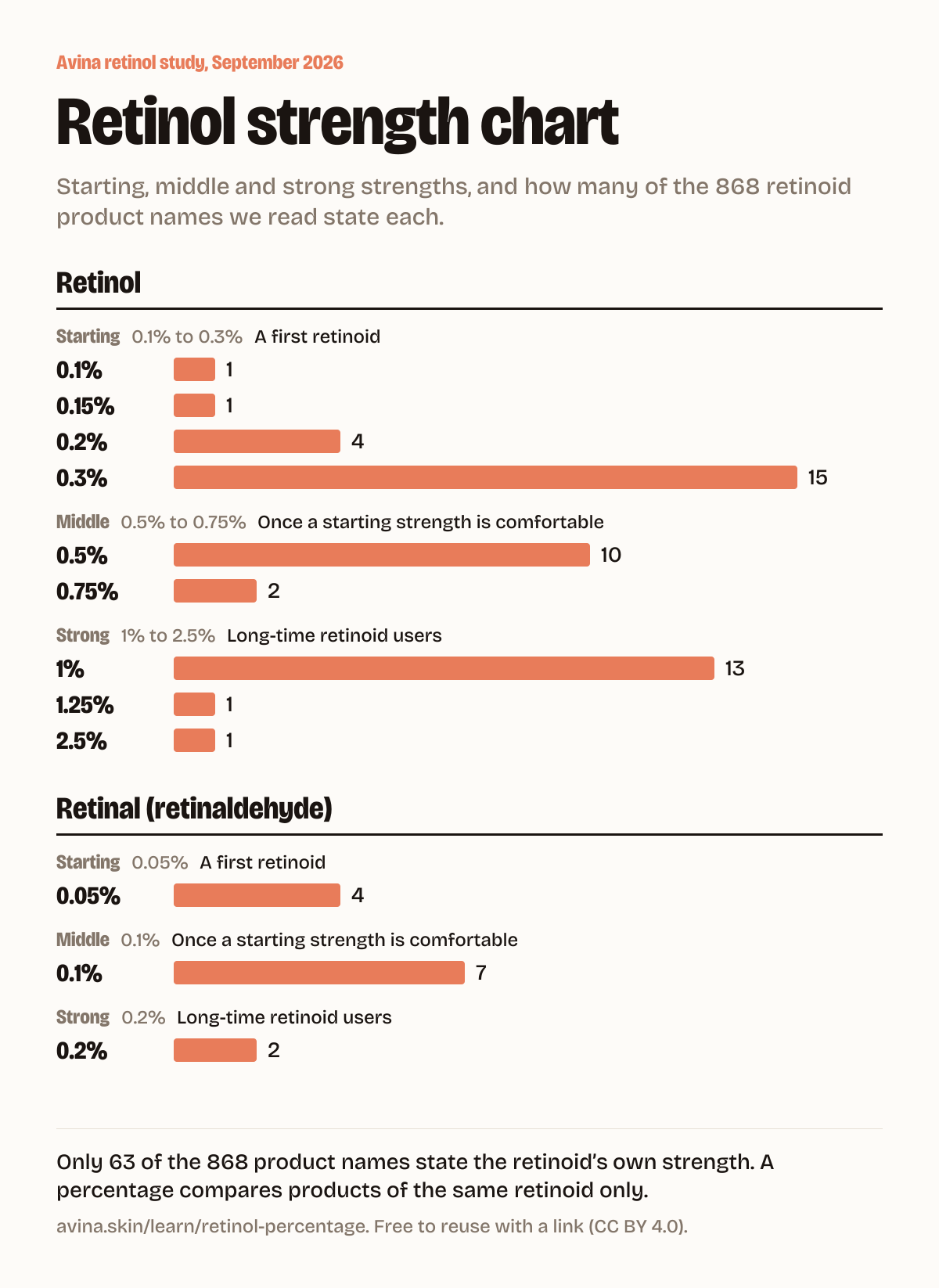
Named retinol strengths cluster at three numbers: 0.3% (15 names), 1% (13 names), 0.5% (10 names). Retinal is sold at much lower numbers, from 0.05% to 0.2%. It is one conversion step closer to retinoic acid, the form skin actually uses (Sorg, 1999), so its percentages are not on the same scale as retinol’s.
For retinol, 0.3% or below; for retinal, around 0.05%. The AAD gives no number: the dermatologist it quotes advises the least intense formula you can find, used every other night and built up slowly. 0.3% is where the largest group of named strengths sits (21 of the 48 retinol strengths named are in the starting band), and it is the most retinol the EU allows in face products. If your skin is sensitive, begin at the low end; our picks for sensitive skin show each product’s stated strength and whether it lists fragrance.
Use it at night, protect your skin from the sun by day, and don’t use a retinoid while pregnant: all three are on the AAD’s retinoid page (see also its pregnancy advice). Move up only when the current strength is comfortable and you want more.
Lower than most people expect. In an 8-week, vehicle-controlled trial run by Johnson & Johnson, a 0.1% retinol moisturizer improved lines and wrinkles more than the same cream without retinol (Tucker-Samaras, 2009). In a randomized, vehicle-controlled trial, a 0.4% retinol lotion reduced fine wrinkling over 24 weeks on the arms of adults with an average age of 87.
The one study we found that compared 0.3% with 1% directly was co-authored by researchers at No7 Beauty Company, part of Walgreens Boots Alliance. In a five-person patch test on the forearm, 0.3% and 1% retinol were similarly effective at remodelling sun-damaged skin; over six weeks of building up to nightly use on the face, 218 people found 0.3% better tolerated, with fewer and milder reactions (Mellody, 2022). Stronger is not the same as better for a first retinoid.
Nothing requires them to. A dermatologist quoted by the AAD notes that over-the-counter products have no standard requirement to disclose the percentage of retinol. A US cosmetic label lists its ingredients in order of amount, not the amounts, and anything at 1% or less can be listed in any order (21 CFR 701.3). Retinol is almost always used at 1% or less, so the ingredient list cannot tell you the strength either.
Packs say more than names. When researchers checked 151 retinol products at nine retailers in Pennsylvania and New Jersey in late 2023, 66 disclosed their retinol percentage (Parikh and Lipoff, 2025). Product names say much less: in our count, 63 of 868 state the retinoid’s own strength. The number, when there is one, is on the front of the box or on the brand’s website.
A name ties a percentage to the retinoid when the number sits beside the retinoid’s name, with at most a describing word between: “0.3% Retinol”, “Retinal 0.1%”, “1% Encapsulated Retinol”. A word like complex or liposome, a trade name or another ingredient in between breaks that tie. Of the 104 names that carry a number, 41 are one of these:
0.1% retinal and 0.1% retinol are not the same dose. Skin converts retinyl esters into retinol, retinol into retinal and retinal into retinoic acid, so each form starts at a different distance from the one that works (the retinoid family, weakest to strongest). Here is which one the 868 products’ ingredient lists contain, each counted once, in this order: adapalene, retinoate, retinal, retinol, then esters.
Esters are not all alike. A 2006 review calls retinol and retinyl esters non-irritating, with only modest clinical results. In lab tests on skin models by Procter & Gamble, which makes Olay, retinyl propionate outscored retinol on two retinoid-related measures and retinyl palmitate had no effect on them; that was not a trial on faces.
If fragrance bothers your skin, the FDA suggests choosing fragrance-free products and checking the ingredient list carefully. Among these retinoid products, moisturizers list fragrance or parfum far more often than serums or eye creams.
For a first retinoid, often. In the No7-co-authored study above, 0.3% retinol caused fewer and milder reactions than 1% over six weeks of building up to nightly use. 1% is also near the top of what names state: 13 names in our count sit at exactly 1%, and only 2 go higher. Start at 0.3% or below and treat 1% as a later step.
No. It is the top of the starting band, the retinol strength named most often (15 of 48), and in the study above it was the better tolerated of the two strengths tested on faces. If your skin is sensitive, start every other night.
It is a middle strength: above the 0.3% most starting products use, well below 1%. The AAD gives no percentage, only the least intense formula, so start at 0.3% or below and treat 0.5% as the next step once that is comfortable.
Not too low to do something. In the 8-week trial run by Johnson & Johnson, 0.1% retinol improved lines and wrinkles more than the same cream without it. In the No7-co-authored patch test, skin thickened step by step from 0.1% to 0.3% to 1% (Mellody, 2022), so a low strength is a reasonable start that may simply do less.
In our count, the highest retinol strength a product name states is 2.5% (1 name), far above the 0.3% the EU allows in face products; 13 names stop at exactly 1%. Big numbers are more often a blend’s: 11 of the 17 blend and trade-name numbers are 2% or more. Prescription tretinoin is a different, stronger drug and is not on this scale.
The percentages cannot settle it. Retinal is one conversion step closer to retinoic acid than retinol, so the same number means a different dose, and there is no agreed exchange rate between the two. In an 8-week split-face trial of 23 people, a retinal cream and a retinol cream at the same strengths (0.05%/0.1%) both reduced wrinkle depth at the crow’s feet, and the retinal side improved more. Compare percentages only between products with the same retinoid.
Because nothing requires it: a dermatologist quoted by the AAD notes there is no standard requirement to disclose it, and retinol sits in the part of the ingredient list that can be in any order. Look on the front of the box and the brand’s website; if neither gives a number, the product has not told you.
In the EU, yes. A rule caps retinol, retinyl acetate and retinyl palmitate at 0.3% retinol equivalent in face and most other products and 0.05% in body lotions, for products placed on the market from November 2025, and requires a vitamin A warning. The US has no such cap. 27 of the retinol strengths named in our count are above the EU face limit.
The counts, charts and data on this page are free to reuse under CC BY 4.0: credit Avina and link to this page.
To cite it:
Avina (2026). Retinol percentages: what 868 retinoid product names state [Data set]. https://avina.skin/learn/retinol-percentage
To put the chart on your page, with its credit link:
<a href="https://avina.skin/learn/retinol-percentage"><img src="https://avina.skin/learn/retinol-percentage/retinol-strength-chart.png" alt="Retinol strength chart: the retinol and retinal percentages products state (Avina)" width="600" height="823"></a>
<p>Source: <a href="https://avina.skin/learn/retinol-percentage">Avina retinol percentage study</a> (CC BY 4.0)</p>More label reading: how to read an ingredients list, and the best retinol serums and creams, where each pick shows its stated strength.
This page counts its own set: the 868 leave-on retinoid face products described under “How we counted” above, as the catalog stood on September 30, 2026. A record is a catalog listing, not a unique formula.
Name matching can miss spelling variants and include incomplete or incorrect records. These are catalog observations, not market estimates, verified formulation analyses or evidence of efficacy. Check your current packaging. Scientific and regulatory facts come from the linked sources separately.
Written by Avina; not clinically reviewed. General information, not a treatment plan. Follow product directions and ask a qualified clinician about conditions, reactions or medicines.
Your routine, organized
Avina holds your morning and evening routines, remembers what you completed, and lets you search the same catalog these numbers came from.
Add Avina as a preferred source on GoogleSo Google shows you more of Avina in Top Stories and AI answers.Add