Avina Picks
The Best Sunscreens for Acne-Prone and Oily Skin
EltaMD's UV Clear Blemish-Prone & Oil Balancing SPF 50 is our pick for acne-prone skin: zinc oxide, 5% niacinamide printed on the carton, and no oil, butter or fragrance on the list. For very oily skin, La Roche-Posay's Anthelios Clear Skin SPF 60; at the drugstore, Neutrogena's Clear Face SPF 50.
Our top picks
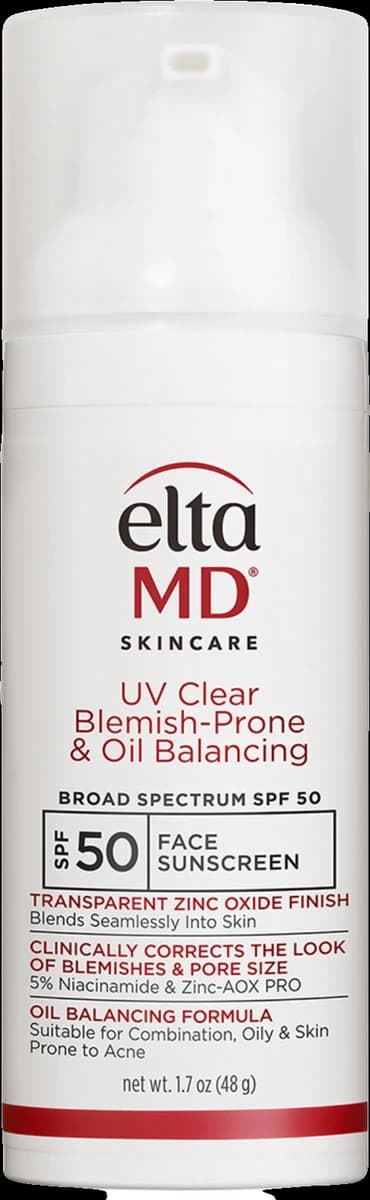 Best overallEltaMD UV Clear Blemish-Prone & Oil Balancing SPF 50
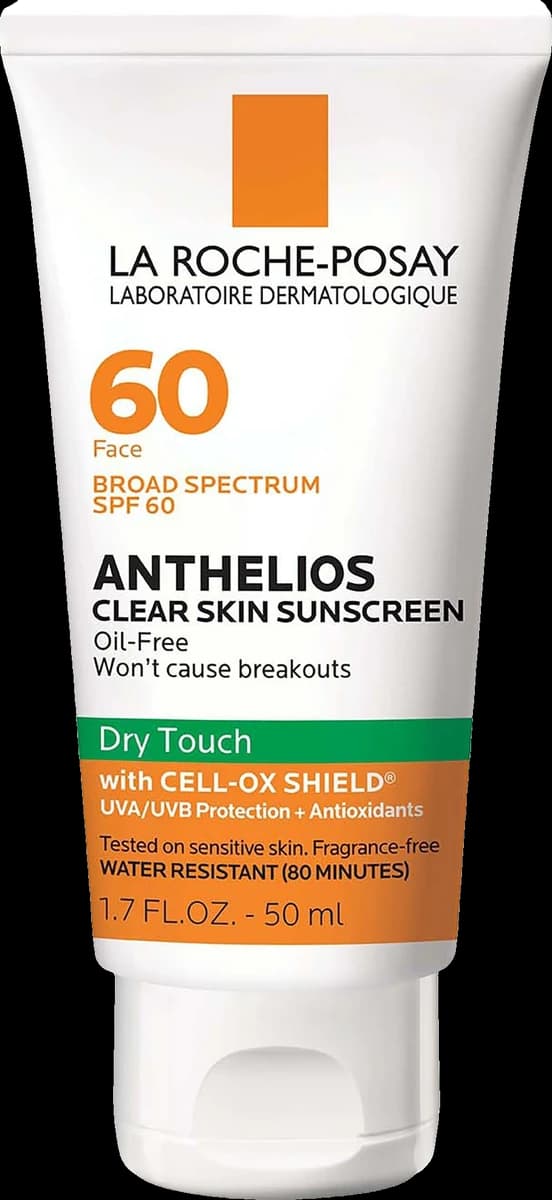 Best sunscreen for oily skinLa Roche-Posay Anthelios Clear Skin Dry Touch Sunscreen SPF 60
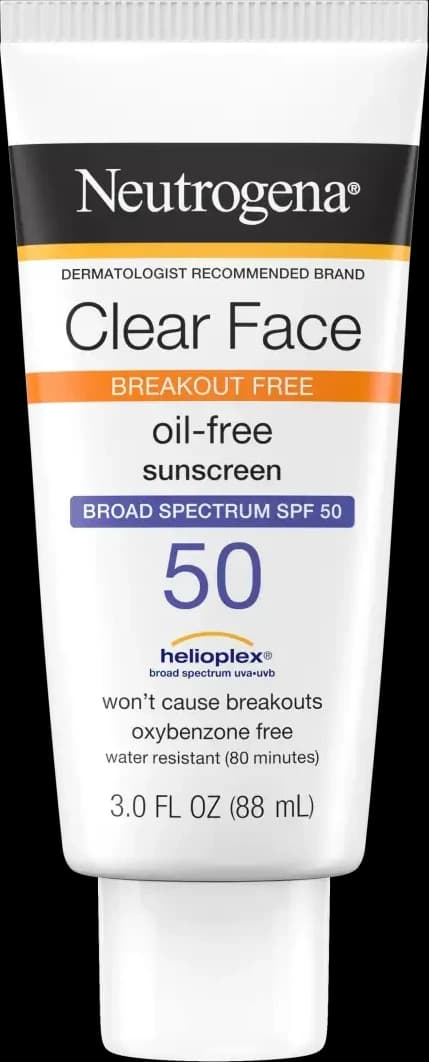 Best drugstore sunscreen for acne-prone skinNeutrogena Clear Face Oil-Free Sunscreen SPF 50
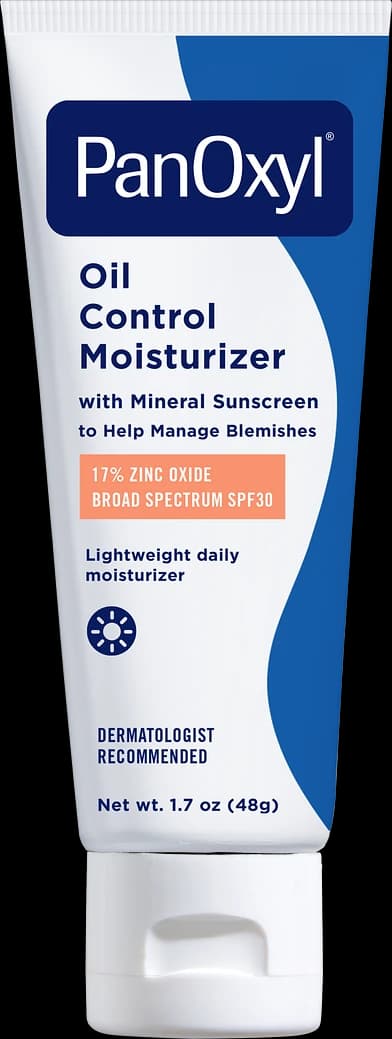 Best mineral sunscreen for acne-prone skinPanOxyl Oil Control Moisturizer with Mineral Sunscreen SPF 30
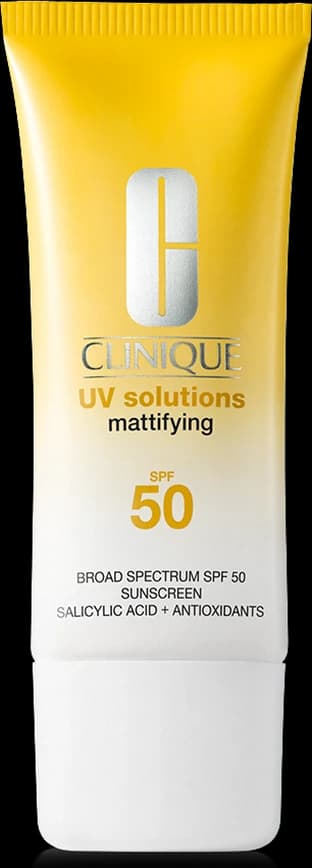 Best matte sunscreen under makeupClinique UV Solutions Mattifying Sunscreen SPF 50
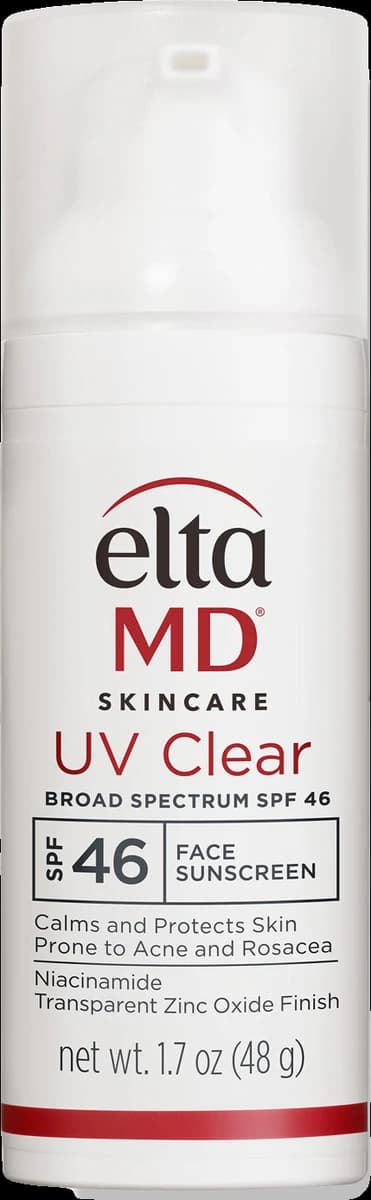 Best sunscreen for acne-prone skin with rednessEltaMD UV Clear SPF 46
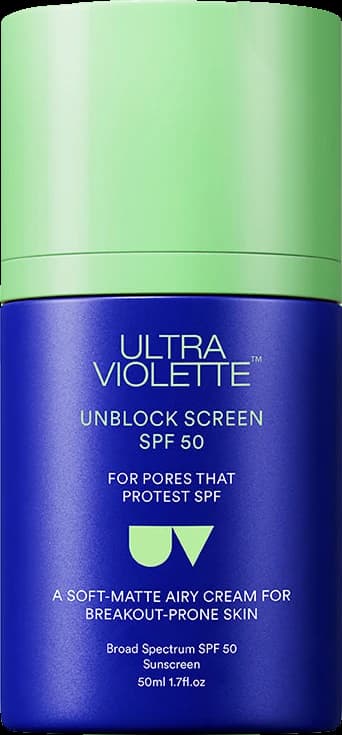 Best sunscreen for hyperpigmentation after acneUltra Violette Unblock Screen SPF 50
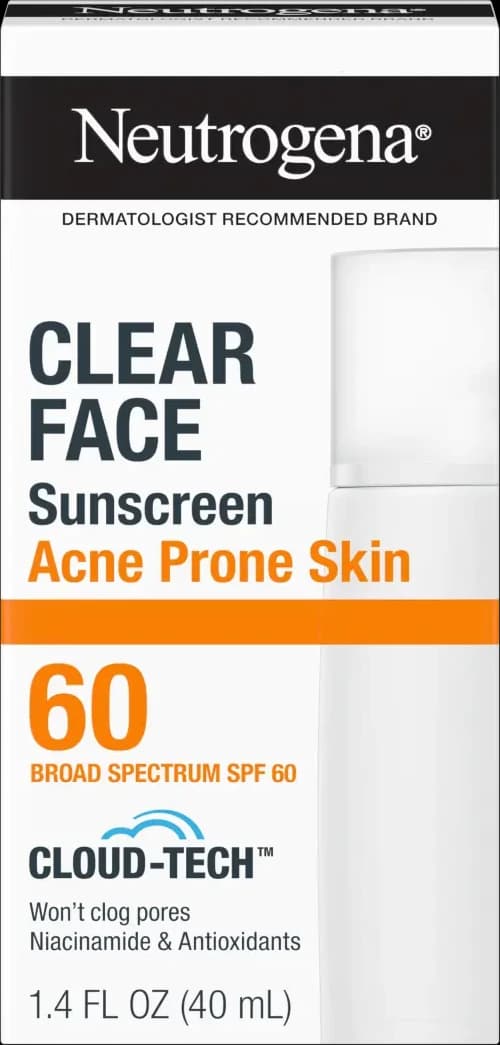 Best bemotrizinol sunscreen for acne-prone skinNeutrogena Clear Face Sunscreen Acne-Prone Skin SPF 60 with BEMT
The short answer
- The best sunscreen for acne-prone skin is EltaMD UV Clear Blemish-Prone & Oil Balancing SPF 50: 11% zinc oxide and 3.5% octinoxate, 5% niacinamide printed on the carton, and no oil, butter, fragrance or drying alcohol on the list.
- For very oily skin, La Roche-Posay Anthelios Clear Skin SPF 60: four oil absorbers, water resistant for 80 minutes. At the drugstore, Neutrogena Clear Face SPF 50, also water resistant.
- Mineral only: PanOxyl Oil Control SPF 30, 17% zinc oxide. Matte under makeup: Clinique UV Solutions Mattifying SPF 50. Redness: EltaMD UV Clear SPF 46. Dark marks: Ultra Violette Unblock Screen SPF 50. The newest filter, bemotrizinol: Neutrogena Clear Face SPF 60 with BEMT.
- On the label, the AAD says to look for “non-comedogenic” or “won’t clog pores” (AAD); its oily-skin page adds zinc oxide and titanium dioxide, with no fragrance or oils (AAD). Neither phrase has a legal definition: the federal sunscreen rule never mentions them (21 CFR 201.327), and a review found “non-comedogenic” regulated by no governing body (Boozalis 2018). So read the list for oils and butters too.
- A name is no guarantee: in our catalog, 20 of 70 face sunscreens pitched at oily or breakout-prone skin by name list an oil, butter, squalane or isopropyl ester.
How we chose: we read the 14 guides Google shows on page 1 for “best sunscreen for acne prone skin”, “best sunscreen for oily skin” and close searches, five store pages and 1,454 comments in 37 Reddit threads, then the current US label of 21 sunscreens: the Drug Facts on DailyMed, or the brand’s US page where DailyMed has none. We kept Broad Spectrum SPF 30 or higher with no plant oil, butter, mineral oil, squalane, isopropyl ester, fragrance or drying alcohol on the list, and a pore or breakout claim on the pack or the brand’s US page. We did not test them on skin. Our method
face sunscreens in Avina’s catalog whose name pitches them at oily or breakout-prone skin (oil-free, matte, oil control, non-comedogenic and the like) list an oil, butter, squalane or isopropyl ester (29%), against 53% of the other 1,374. They list an oil-absorbing powder more often (87% against 63%) and fragrance about as often (34% against 37%). Those names list an oil less often, but only the list tells you.
The best sunscreen for your skin
- Acne-prone skin, most people: EltaMD UV Clear Blemish-Prone SPF 50: zinc oxide and 5% niacinamide, with no oils or fragrance.
- Very oily skin, shiny by midday: La Roche-Posay Anthelios Clear Skin SPF 60: four oil absorbers, water resistant for 80 minutes.
- Combination skin: EltaMD UV Clear Blemish-Prone SPF 50: its carton names combination, oily and acne-prone skin.
- At the drugstore: Neutrogena Clear Face SPF 50, or Neutrogena Clear Face SPF 60 with BEMT.
- Mineral filters only: PanOxyl Oil Control SPF 30. For zinc oxide with titanium dioxide, see mineral or chemical.
- Under makeup: Clinique UV Solutions Mattifying SPF 50.
- Redness or rosacea with acne: EltaMD UV Clear SPF 46.
- Dark marks left by breakouts: Ultra Violette Unblock Screen SPF 50, and our tinted sunscreen picks.
- Deep skin tones: Our four chemical-only picks list no white mineral filter: Neutrogena Clear Face SPF 60 with BEMT, for one, or La Roche-Posay Anthelios Clear Skin SPF 60, which is also water resistant. The AAD’s answer to a white cast is a tinted sunscreen that matches your skin tone, such as our tinted sunscreen pick for dark skin tones.
- The newest UV filter, bemotrizinol: Neutrogena Clear Face SPF 60 with BEMT, at 6%.
- Sweat and swimming: La Roche-Posay Anthelios Clear Skin SPF 60 (80 minutes) and Neutrogena Clear Face SPF 50 (80 minutes).
- On tretinoin, adapalene, benzoyl peroxide or doxycycline: See sunscreen with acne medication.
- A Korean formula: Our lightweight Korean sun gel pick, Isntree Hyaluronic Acid Daily Sun Gel SPF 30, lists no oil, butter or fragrance. Our Korean pick for oily skin lists isopropyl palmitate, an isopropyl ester this page screens out.
- A moisturizer with SPF: Our oily-skin moisturizers with SPF.
- Sensitive and oily skin: Our sensitive-skin pick for oily skin.
Best overall: EltaMD UV Clear Blemish-Prone & Oil Balancing SPF 50
11% zinc oxide and 3.5% octinoxate, SPF 50, with 5% niacinamide printed on the carton. No fragrance and no drying alcohol, no oil or butter on the list, and the carton says non-comedogenic and won't clog pores.
- Mineral and chemical
- SPF 50
- No oils listed
- No added fragrance
Good for: EltaMD UV Clear Blemish-Prone & Oil Balancing SPF 50
- Combination, oily and acne-prone skin (the skin types its carton names)
- SPF 50 with zinc oxide in the filter mix
- Skin that does well with niacinamide
Skip it if: EltaMD UV Clear Blemish-Prone & Oil Balancing SPF 50
- You swim or sweat: it is not water resistant
- Niacinamide breaks you out or stings
- You want oil-absorbing powders: it lists none
Label facts for EltaMD UV Clear Blemish-Prone & Oil Balancing SPF 50
- UV filters
- Zinc oxide 11% and octinoxate 3.5%
- Filter type
- Mineral and chemical
- SPF
- 50, as the name states
- Tint
- Untinted
- Water resistant
- No
- Oils and butters
- None listed
- Oil absorbers
- None listed
- Added fragrance
- None listed
- Drying alcohol
- None listed
- Supporting
- Niacinamide, bisabolol, hyaluronic acid and vitamin E
- Cruelty-free certified
- No
Read from the US carton on DailyMed on November 3, 2026. US sunscreens print each UV filter’s percentage; their other ingredients may be listed alphabetically, so these label facts report only whether something is there. Formulas change; check your box. Cruelty-free certification: the Leaping Bunny and Cruelty Free International directories on October 10, 2026.
Why we picked it: EltaMD UV Clear Blemish-Prone & Oil Balancing SPF 50
EltaMD added it to its UV Clear line in 2026, and the original UV Clear SPF 46 is the sunscreen the page-1 guides we read pick most. This one is made for this search: its carton names combination, oily and acne-prone skin, and prints both of the AAD’s label phrases, non-comedogenic and won’t clog pores. It has more zinc oxide than the original (11% against 9%), and La Roche-Posay’s Clear Skin, our pick for very oily skin, has none.
The two EltaMD picks are different formulas with different labels. Here, “oil balancing” is EltaMD’s claim, from its own 12-week study of 43 people (EltaMD); the list puts niacinamide 3rd and has no oil-absorbing powder. Some Reddit users blame EltaMD’s niacinamide for breakouts or hives (an r/SkincareAddiction thread), so if it bothers you, see the picks below.
Flaws but not dealbreakers: EltaMD UV Clear Blemish-Prone & Oil Balancing SPF 50
- Not water resistant: the directions say to use a water-resistant sunscreen if you swim or sweat.
- No oil-absorbing powder on the list.
- Lists pongamia seed and ginger root extracts near the end (16th and 20th of 20).
- Octinoxate is a chemical filter, so it is not mineral only.
- DailyMed's typed ingredient text also names canola oil, BHT and phosphoric acid, which the carton does not print; we follow the carton.
EltaMD UV Clear Blemish-Prone & Oil Balancing SPF 50
EltaMD UV Clear Blemish-Prone & Oil Balancing SPF 50 ingredients (full list of 20, UV filters marked)
Active ingredients: Octinoxate 3.5%, Zinc Oxide 11.0%
Inactive ingredients: Water, Dimethicone, Niacinamide, Octyldodecyl Neopentanoate, Ethylhexyl Methoxycrylene, Butyloctyl Salicylate, Hydroxyethyl Acrylate/Sodium Acryloyldimethyl Taurate Copolymer, Phenoxyethanol, Polyisobutene, Triethoxycaprylylsilane, Tocopheryl Acetate, Carnosine, Bisabolol, Tocopherol, PEG-7 Trimethylolpropane Coconut Ether, Pongamia Pinnata Seed Extract, Oleth-3 Phosphate, Lactic Acid, Sodium Hyaluronate, Zingiber Officinale (Ginger) Root Extract
As printed on the US carton on DailyMed on November 3, 2026. The list printed on your box is the one that counts.
Best sunscreen for oily skin: La Roche-Posay Anthelios Clear Skin Dry Touch Sunscreen SPF 60
Four chemical filters, SPF 60, water resistant for 80 minutes, with four oil absorbers: silica (2nd), methyl methacrylate crosspolymer (6th), nylon-12 (7th) and perlite (10th). No fragrance and no drying alcohol, and no oil or butter on the list.
- Chemical only
- SPF 60
- No oils listed
- No added fragrance
Good for: La Roche-Posay Anthelios Clear Skin Dry Touch Sunscreen SPF 60
- Very oily skin and shine by midday
- Hot, humid days, sweat and swimming: water resistant for 80 minutes
- A matte finish (La Roche-Posay says it leaves skin appearing matte)
Skip it if: La Roche-Posay Anthelios Clear Skin Dry Touch Sunscreen SPF 60
- You want zinc oxide: all four filters are chemical
- You avoid beeswax
- Dry skin
Label facts for La Roche-Posay Anthelios Clear Skin Dry Touch Sunscreen SPF 60
- UV filters
- Avobenzone 3%, homosalate 15%, octisalate 5% and octocrylene 7%
- Filter type
- Chemical only
- SPF
- 60, as the name states
- Tint
- Untinted
- Water resistant
- 80 minutes, as the label states
- Oils and butters
- None listed
- Oil absorbers
- Silica, perlite, nylon-12 and methyl methacrylate crosspolymer
- Added fragrance
- None listed
- Drying alcohol
- None listed
- Supporting
- Vitamin E
- Cruelty-free certified
- No
Read from the US Drug Facts label on DailyMed on November 3, 2026. US sunscreens print each UV filter’s percentage; their other ingredients may be listed alphabetically, so these label facts report only whether something is there. Formulas change; check your box. Cruelty-free certification: the Leaping Bunny and Cruelty Free International directories on October 10, 2026.
Why we picked it: La Roche-Posay Anthelios Clear Skin Dry Touch Sunscreen SPF 60
Teen Vogue and NBC Select both give it their oily-skin award, and its US label backs them: silica comes right after water, three more oil absorbers follow, and there is no oil or butter. The pack prints oil-free, non comedogenic, won’t clog pores and fragrance-free, and La Roche-Posay says it leaves skin appearing matte. Of our picks, it is the only one that prints the AAD’s words and is also water resistant.
It beat Neutrogena Clear Face SPF 50, which lists two absorbers and says “won’t cause breakouts” rather than the AAD’s words; Clinique UV Solutions Mattifying SPF 50, whose only oil absorber by our count is silica and which is not water resistant; and Eucerin Clear Skin SPF 50, which lists alcohol denat. 2nd.
Flaws but not dealbreakers: La Roche-Posay Anthelios Clear Skin Dry Touch Sunscreen SPF 60
- All four filters are chemical, though the AAD's oily-skin page suggests zinc oxide and titanium dioxide.
- Lists beeswax (11th of 29).
- Lists t-butyl alcohol, a solvent, 28th of 29; not alcohol denat.
La Roche-Posay Anthelios Clear Skin Dry Touch Sunscreen SPF 60
La Roche-Posay Anthelios Clear Skin Dry Touch Sunscreen SPF 60 ingredients (full list of 29, UV filters marked)
Active ingredients: Avobenzone 3%, Homosalate 15%, Octisalate 5%, Octocrylene 7%
Inactive ingredients: Water, Silica, Dicaprylyl Carbonate, Styrene/Acrylates Copolymer, Butyloctyl Salicylate, Methyl Methacrylate Crosspolymer, Nylon-12, PEG-100 Stearate, Glyceryl Stearate, Perlite, Beeswax, Ammonium Polyacryloyldimethyl Taurate, Phenoxyethanol, PEG-8 Laurate, Behenyl Alcohol, Sodium Stearoyl Glutamate, Chlorphenesin, p-Anisic Acid, Xanthan Gum, Tocopherol, Disodium EDTA, Arachidyl Alcohol, Diethylhexyl Syringylidenemalonate, Propylene Glycol, Cassia Alata Leaf Extract, Maltodextrin, Stearyl Alcohol, t-Butyl Alcohol, Caprylic/Capric Triglyceride
As printed on the US Drug Facts label on DailyMed on November 3, 2026. The list printed on your box is the one that counts.
Best drugstore sunscreen for acne-prone skin: Neutrogena Clear Face Oil-Free Sunscreen SPF 50
Four chemical filters, SPF 50, water resistant for 80 minutes, with silica (2nd) and aluminum starch octenylsuccinate (8th) to soak up oil, in a 3 fl oz tube. No fragrance and no drying alcohol, and no oil or butter on the list.
- Chemical only
- SPF 50
- No oils listed
- No added fragrance
Good for: Neutrogena Clear Face Oil-Free Sunscreen SPF 50
- A drugstore brand in a big tube
- Sweat and swimming: water resistant for 80 minutes
- Oily, acne-prone skin
Skip it if: Neutrogena Clear Face Oil-Free Sunscreen SPF 50
- You want zinc oxide: its four filters are chemical
- Cedarwood or cinnamon extracts bother your skin
- You want the AAD's exact words on the pack
Label facts for Neutrogena Clear Face Oil-Free Sunscreen SPF 50
- UV filters
- Avobenzone 3%, homosalate 10%, octisalate 5% and octocrylene 10%
- Filter type
- Chemical only
- SPF
- 50, as the name states
- Tint
- Untinted
- Water resistant
- 80 minutes, as the label states
- Oils and butters
- None listed
- Oil absorbers
- Silica and aluminum starch octenylsuccinate
- Added fragrance
- None listed
- Drying alcohol
- None listed
- Supporting
- Bisabolol
- Cruelty-free certified
- No
Read from the US Drug Facts label on DailyMed on November 3, 2026. US sunscreens print each UV filter’s percentage; their other ingredients may be listed alphabetically, so these label facts report only whether something is there. Formulas change; check your box. Cruelty-free certification: the Leaping Bunny and Cruelty Free International directories on October 10, 2026.
Why we picked it: Neutrogena Clear Face Oil-Free Sunscreen SPF 50
NBC Select’s best drugstore pick, and the third result in Amazon’s search for acne-prone sunscreen when we looked on November 3, 2026. The tube says breakout free, oil-free and fragrance-free; the list puts silica 2nd and has no oil, butter or drying alcohol.
It beat Eucerin Clear Skin SPF 50, which lists alcohol denat. 2nd and is not water resistant, and PanOxyl Oil Control SPF 30, which is not water resistant either and wins our mineral award instead. It is a different formula from Neutrogena Clear Face SPF 60 with BEMT, our bemotrizinol pick: other filters, another list.
Flaws but not dealbreakers: Neutrogena Clear Face Oil-Free Sunscreen SPF 50
- All four filters are chemical.
- Lists cedarwood bark and cinnamon bark extracts near the end (29th and 30th of 31): aromatic plant extracts, though the tube says fragrance-free.
- The tube says won't cause breakouts, not the AAD's non-comedogenic or won't clog pores.
Neutrogena Clear Face Oil-Free Sunscreen SPF 50
Neutrogena Clear Face Oil-Free Sunscreen SPF 50 ingredients (full list of 31, UV filters marked)
Active ingredients: Avobenzone (3%), Homosalate (10%), Octisalate (5%), Octocrylene (10%)
Inactive ingredients: Water, Silica, Cetyl Dimethicone, Styrene/Acrylates Copolymer, C12-15 Alkyl Benzoate, Steareth-100, Ethylhexylglycerin, Aluminum Starch Octenylsuccinate, Phenoxyethanol, Caprylyl Glycol, Sodium Polyacrylate, Dimethicone, Steareth-2, Polyester-7, Chlorphenesin, Ethylhexyl Stearate, Disodium EDTA, Propylene Glycol, Neopentyl Glycol Diheptanoate, Bisabolol, Acrylates/Dimethicone Copolymer, Butylene Glycol, Mannan, Xanthan Gum, BHT, Capryloyl Glycine, Trideceth-6, Sarcosine, Cedrus Atlantica Bark Extract, Cinnamomum Zeylanicum Bark Extract, Portulaca Oleracea Extract
As printed on the US Drug Facts label on DailyMed on November 3, 2026. The list printed on your box is the one that counts.
Best mineral sunscreen for acne-prone skin: PanOxyl Oil Control Moisturizer with Mineral Sunscreen SPF 30
17% zinc oxide as the only active ingredient, SPF 30, with tapioca starch (2nd) and polymethylsilsesquioxane (20th) to soak up oil, and hyaluronic acid. No fragrance and no drying alcohol, no oil or butter on the list, and the carton says won't clog pores.
- Mineral only
- SPF 30
- No oils listed
- No added fragrance
Good for: PanOxyl Oil Control Moisturizer with Mineral Sunscreen SPF 30
- Mineral-only filters
- Oily skin that still wants a light moisturizer (it adds hyaluronic acid)
- Sensitive skin on a retinoid (the AAD's retinoid page suggests zinc oxide or titanium dioxide for sensitive skin)
Skip it if: PanOxyl Oil Control Moisturizer with Mineral Sunscreen SPF 30
- You want more than SPF 30
- You swim or sweat: it is not water resistant
- Zinc oxide shows as a cast on your skin tone
Label facts for PanOxyl Oil Control Moisturizer with Mineral Sunscreen SPF 30
- UV filters
- Zinc oxide 17%
- Filter type
- Mineral only
- SPF
- 30, as the name states
- Tint
- Untinted
- Water resistant
- No
- Oils and butters
- None listed
- Oil absorbers
- Polymethylsilsesquioxane and tapioca starch
- Added fragrance
- None listed
- Drying alcohol
- None listed
- Supporting
- Glycerin, bisabolol, hyaluronic acid, caffeine and vitamin E
- Cruelty-free certified
- No
Read from the US carton on DailyMed on November 3, 2026. US sunscreens print each UV filter’s percentage; their other ingredients may be listed alphabetically, so these label facts report only whether something is there. Formulas change; check your box. Cruelty-free certification: the Leaping Bunny and Cruelty Free International directories on October 10, 2026.
Why we picked it: PanOxyl Oil Control Moisturizer with Mineral Sunscreen SPF 30
Of the 18 labels on this page, the closest to the AAD’s advice for oily skin: zinc oxide, no oils and no fragrance. It lacks only titanium dioxide, which none of them pairs with zinc oxide (see mineral or chemical). The carton says won’t clog pores, and free from fragrances and chemical sunscreen actives; PanOxyl’s website adds a matte finish and no white cast, which are its claims, not ours.
It beat Hero Force Shield Superlight SPF 30, the other zinc-only label here, which lists caprylic/capric triglyceride 2nd, plus raspberry seed oil and moringa oleifera seed oil.
Flaws but not dealbreakers: PanOxyl Oil Control Moisturizer with Mineral Sunscreen SPF 30
- SPF 30, the AAD's minimum.
- Not water resistant.
- Zinc oxide only: no titanium dioxide, the AAD's second mineral.
PanOxyl Oil Control Moisturizer with Mineral Sunscreen SPF 30
PanOxyl Oil Control Moisturizer with Mineral Sunscreen SPF 30 ingredients (full list of 25, UV filters marked)
Active ingredients: Zinc Oxide 17%
Inactive ingredients: Aqua, Tapioca Starch, C12-15 Alkyl Benzoate, Butyloctyl Salicylate, Polyglyceryl-4 Laurate/Succinate, Sorbitan Stearate, Glycerin, Polyhydroxystearic Acid, Hydroxyethyl Acrylate/Sodium Acryloyldimethyl Taurate Copolymer, Caprylyl Glycol, Tocopheryl Acetate (Vitamin E), Sodium Hyaluronate, Caffeine, Hydroxyacetophenone, Bisabolol, Ethylhexylglycerin, Sorbitan Isostearate, Xanthan Gum, Tetrasodium Glutamate Diacetate, Polymethylsilsesquioxane, Polysorbate 60, 1,2-Hexanediol, Triethoxycaprylylsilane, Phenethyl Alcohol, Sodium Hydroxide
As printed on the US carton on DailyMed on November 3, 2026. The list printed on your box is the one that counts.
Best matte sunscreen under makeup: Clinique UV Solutions Mattifying Sunscreen SPF 50
Four chemical filters, SPF 50, with silica 4th on the list to soak up oil. No fragrance and no drying alcohol, no oil or butter on the list, and the carton says sheer matte finish, oil free and non-pore clogging.
- Chemical only
- SPF 50
- No oils listed
- No added fragrance
Good for: Clinique UV Solutions Mattifying Sunscreen SPF 50
- Under makeup (Clinique says to apply it before makeup)
- Shine by midday (Clinique says it keeps excess shine in check all day)
- Fragrance-free routines
Skip it if: Clinique UV Solutions Mattifying Sunscreen SPF 50
- You swim or sweat: it is not water resistant
- You want zinc oxide: its four filters are chemical
- Salicylic acid irritates your skin
Label facts for Clinique UV Solutions Mattifying Sunscreen SPF 50
- UV filters
- Avobenzone 3%, homosalate 7%, octisalate 4.5% and octocrylene 7%
- Filter type
- Chemical only
- SPF
- 50, as the name states
- Tint
- Untinted
- Water resistant
- No
- Oils and butters
- None listed
- Oil absorbers
- Silica
- Added fragrance
- None listed
- Drying alcohol
- None listed
- Supporting
- Glycerin, hyaluronic acid and vitamin E
- Cruelty-free certified
- No
Read from the US carton on DailyMed and Clinique's US website on November 3, 2026. US sunscreens print each UV filter’s percentage; their other ingredients may be listed alphabetically, so these label facts report only whether something is there. Formulas change; check your box. Cruelty-free certification: the Leaping Bunny and Cruelty Free International directories on October 10, 2026.
Why we picked it: Clinique UV Solutions Mattifying Sunscreen SPF 50
The carton promises a sheer matte finish, calls it oil free and non-pore clogging, Clinique’s wording for the AAD’s won’t clog pores, and says 100% fragrance free; Clinique’s website says to apply it before makeup. The list backs the matte: silica is 4th, with no oil, butter or drying alcohol.
It beat three other matte sunscreens: Murad Superactive SPF 50 lists fragrance, bitter orange peel oil, avocado oil and hydrogenated vegetable oil; Shiseido Urban Environment Oil-Control SPF 40 lists SD Alcohol 40-B 4th and fragrance; and Black Girl Sunscreen Make It Matte SPF 45 lists shea butter, coconut oil and squalane.
Flaws but not dealbreakers: Clinique UV Solutions Mattifying Sunscreen SPF 50
- Not water resistant.
- Salicylic acid is an inactive ingredient here (14th of 34), not a labeled acne active, and the carton gives no strength.
- All four filters are chemical.
Clinique UV Solutions Mattifying Sunscreen SPF 50
Clinique UV Solutions Mattifying Sunscreen SPF 50 ingredients (full list of 34, UV filters marked)
Active ingredients: Avobenzone 3%, Homosalate 7%, Octisalate 4.5%, Octocrylene 7%
Inactive ingredients: Water\Aqua\Eau, Glycerin, Phenyl Trimethicone, Silica, Dextrin Palmitate, Butyloctyl Salicylate, Butylene Glycol, Triacontanyl PVP, Hydrogenated Lecithin, Tocopherol, Sodium Hyaluronate, Algae Extract, Litchi Chinensis Seed Extract, Salicylic Acid, Caprylyl Glycol, Oryzanol, Dicetyldimonium Chloride, Phosphatidylcholine, 7-Dehydrocholesterol, Hydroxyethyl Acrylate/Sodium Acryloyldimethyl Taurate Copolymer, Ammonium Acryloyldimethyltaurate/Beheneth-25 Methacrylate Crosspolymer, Glyceryl Stearate, PEG-100 Stearate, Sorbitan Isostearate, Polysorbate 20, Polysorbate 60, Isododecane, Xanthan Gum, Acrylates/Dimethicone Copolymer, Dextrin, Tocopheryl Acetate, Disodium EDTA, Phenoxyethanol, Sodium Benzoate
As printed on the US carton on DailyMed and Clinique's US website on November 3, 2026. The list printed on your box is the one that counts.
Best sunscreen for acne-prone skin with redness: EltaMD UV Clear SPF 46
9% zinc oxide and 7.5% octinoxate, SPF 46, in 16 inactive ingredients with no plant extract. No fragrance and no drying alcohol, no oil or butter on the list, and the carton says it calms and protects skin prone to acne and rosacea.
- Mineral and chemical
- SPF 46
- No oils listed
- No added fragrance
Good for: EltaMD UV Clear SPF 46
- Acne-prone skin with redness or rosacea
- Sensitive, acne-prone skin that does best with a short list
- Skin that does well with niacinamide
Skip it if: EltaMD UV Clear SPF 46
- You swim or sweat: it is not water resistant
- Niacinamide breaks you out (some Reddit users blame it)
- You want mineral-only filters: see PanOxyl Oil Control SPF 30, our mineral pick
Label facts for EltaMD UV Clear SPF 46
- UV filters
- Zinc oxide 9% and octinoxate 7.5%
- Filter type
- Mineral and chemical
- SPF
- 46, as the name states
- Tint
- Untinted
- Water resistant
- No
- Oils and butters
- None listed
- Oil absorbers
- None listed
- Added fragrance
- None listed
- Drying alcohol
- None listed
- Supporting
- Niacinamide, hyaluronic acid and vitamin E
- Cruelty-free certified
- No
Read from the US carton on DailyMed and EltaMD's US website on November 3, 2026. US sunscreens print each UV filter’s percentage; their other ingredients may be listed alphabetically, so these label facts report only whether something is there. Formulas change; check your box. Cruelty-free certification: the Leaping Bunny and Cruelty Free International directories on October 10, 2026.
Why we picked it: EltaMD UV Clear SPF 46
The sunscreen the page-1 guides we read pick most: six of the 12 guides with picks choose it, four as best overall. Its carton is the only one we read for this page that names rosacea, and its list is the shortest of our picks, with no plant extract and the carton’s non-comedogenic claim.
The 5% niacinamide is EltaMD’s website claim: the current carton lists niacinamide 3rd with no strength, and no longer says oil-free, though EltaMD’s site and its Amazon listing still do. It beat SkinCeuticals Clear Daily Soothing SPF 50, which pairs zinc oxide with three chemical filters in 27 inactive ingredients. Its tinted version, the acne-prone pick in our tinted sunscreen picks, is a different list: it adds iron oxides and isopropyl palmitate, an isopropyl ester our screen leaves out.
Flaws but not dealbreakers: EltaMD UV Clear SPF 46
- Not water resistant.
- Octinoxate is a chemical filter.
- No oil absorbers on the list.
- The current carton no longer says oil-free; EltaMD's website and Amazon listing still do.
EltaMD UV Clear SPF 46
EltaMD UV Clear SPF 46 ingredients (full list of 16, UV filters marked)
Active ingredients: Octinoxate 7.5%, Zinc Oxide 9.0%
Inactive ingredients: Water, Cyclopentasiloxane, Niacinamide, Octyldodecyl Neopentanoate, Hydroxyethyl Acrylate/Sodium Acryloyldimethyl Taurate Copolymer, Butylene Glycol, Phenoxyethanol, Polyisobutene, Triethoxycaprylylsilane, Tocopheryl Acetate, PEG-7 Trimethylolpropane Coconut Ether, Oleth-3 Phosphate, Iodopropynyl Butylcarbamate, Lactic Acid, Sodium Hyaluronate, Phosphoric Acid
As printed on the US carton on DailyMed and EltaMD's US website on November 3, 2026. The list printed on your box is the one that counts.
Best sunscreen for hyperpigmentation after acne: Ultra Violette Unblock Screen SPF 50
10% zinc oxide, 6% octocrylene and 3% bemotrizinol, SPF 50, tinted with three iron oxides, with silica 5th on the list. No fragrance and no drying alcohol, and no oil or butter on the list.
- Mineral and chemical
- SPF 50
- No oils listed
- No added fragrance
Good for: Ultra Violette Unblock Screen SPF 50
- Dark marks left by breakouts
- Oily, breakout-prone skin that wants a soft-matte finish (Ultra Violette's words)
- Trying bemotrizinol, the UV filter the FDA allowed in 2026
Skip it if: Ultra Violette Unblock Screen SPF 50
- Its one tint does not suit your skin tone (Ultra Violette says it may leave a white cast on deeper skin tones)
- You swim or sweat: it is not water resistant
- You want an oil-free product: Ultra Violette says it is not
Label facts for Ultra Violette Unblock Screen SPF 50
- UV filters
- Zinc oxide 10%, octocrylene 6% and bemotrizinol 3%
- Filter type
- Mineral and chemical
- SPF
- 50, as the name states
- Tint
- Tinted (iron oxides)
- Water resistant
- No
- Oils and butters
- None listed
- Oil absorbers
- Silica
- Added fragrance
- None listed
- Drying alcohol
- None listed
- Supporting
- Iron oxides
- Cruelty-free certified
- No
Read from the US carton on DailyMed on November 3, 2026. US sunscreens print each UV filter’s percentage; their other ingredients may be listed alphabetically, so these label facts report only whether something is there. Formulas change; check your box. Cruelty-free certification: the Leaping Bunny and Cruelty Free International directories on November 3, 2026.
Why we picked it: Ultra Violette Unblock Screen SPF 50
The AAD’s advice for dark spots in darker skin tones is a tinted sunscreen with iron oxide, SPF 30 or higher, broad spectrum, and non-comedogenic if your skin is oily. Of the 18 labels on this page, this is the only one that lists iron oxides and no fragrance. Its pack says it is for breakout-prone skin; Ultra Violette calls it fragrance-free, soft-matte, non-comedogenic and non-acnegenic, and cites its own 28-day study of 21 people (Ultra Violette). Its carton says cruelty free, but neither cruelty-free directory we use lists the brand.
It beat Murad Superactive SPF 50 and Shiseido Urban Environment Oil-Control SPF 40, the other two labels here with iron oxides, which both list fragrance, and Neutrogena Clear Face SPF 60 with BEMT, which has no iron oxides. The same AAD page also asks for water resistance and a tint that blends with your skin tone; this one is not water resistant and comes in one tint, which Ultra Violette says may leave a white cast on deeper skin tones. For more shades, see our tinted sunscreen pick for melasma and dark spots.
Flaws but not dealbreakers: Ultra Violette Unblock Screen SPF 50
- One tint only (Ultra Violette calls it subtle).
- Not water resistant.
- Ultra Violette's FAQ says it is not oil-free, though the list names no oil.
- In the US it is sold only by Ultra Violette and Sephora.
Ultra Violette Unblock Screen SPF 50 ingredients (full list of 34, UV filters marked)
Active ingredients: Bemotrizinol 3%, Octocrylene 6%, Zinc Oxide 10%
Inactive ingredients: Water, Butyloctyl Salicylate, Heptyl Undecylenate, Cetearyl Alcohol, Silica, Ethylhexyl Methoxycylene, Copernicia Cerifera (Carnauba) Wax, Microcrystalline Cellulose, Saccharide Isomerate, Cetyl Alcohol, Phenoxyethanol, Hydroxyacetophenone, Disodium Lauriminodipropionate Tocopheryl Phosphates, Polyhydroxystearic Acid, Triethoxycaprylylsilane, Cellulose Gum, Maltodextrin, Benzyl Alcohol, Bixa Orellana Seed Extract, Epilobium Angustifolium Flower/Leaf/Stem Extract, Oryza Sativa (Rice) Bran Wax, Sodium Stearoyl Glutamate, Xanthan Gum, Disodium EDTA, Ethyl Linoleate, Pentylene Glycol, Lactic Acid, Citric Acid, Sodium Citrate, Sodium Metabisulfite, Sodium Hydroxide, Iron Oxides (CI 77492), Iron Oxides (CI 77491), Iron Oxides (CI 77499)
As printed on the US carton on DailyMed on November 3, 2026. The list printed on your box is the one that counts.
Best bemotrizinol sunscreen for acne-prone skin: Neutrogena Clear Face Sunscreen Acne-Prone Skin SPF 60 with BEMT
3% avobenzone, 15% homosalate, 5% octisalate and 6% bemotrizinol, SPF 60, with no zinc oxide or titanium dioxide, and silica 4th of its 17 inactive ingredients. No fragrance and no drying alcohol, no oil or butter on the list, and the carton says acne prone skin, won't clog pores and makeup wear.
- Chemical only
- SPF 60
- No oils listed
- No added fragrance
Good for: Neutrogena Clear Face Sunscreen Acne-Prone Skin SPF 60 with BEMT
- Deep skin tones that show zinc oxide
- Under makeup (its carton says makeup wear)
- Trying bemotrizinol from a drugstore brand
Skip it if: Neutrogena Clear Face Sunscreen Acne-Prone Skin SPF 60 with BEMT
- You swim or sweat: it is not water resistant
- You want mineral filters
- You want a big bottle: it is 1.4 fl oz
Label facts for Neutrogena Clear Face Sunscreen Acne-Prone Skin SPF 60 with BEMT
- UV filters
- Avobenzone 3%, homosalate 15%, octisalate 5% and bemotrizinol 6%
- Filter type
- Chemical only
- SPF
- 60, as the name states
- Tint
- Untinted
- Water resistant
- No
- Oils and butters
- None listed
- Oil absorbers
- Silica and aluminum starch octenylsuccinate
- Added fragrance
- None listed
- Drying alcohol
- None listed
- Supporting
- Niacinamide and vitamin E
- Cruelty-free certified
- No
Read from the US carton on DailyMed on November 3, 2026. US sunscreens print each UV filter’s percentage; their other ingredients may be listed alphabetically, so these label facts report only whether something is there. Formulas change; check your box. Cruelty-free certification: the Leaping Bunny and Cruelty Free International directories on October 10, 2026.
Why we picked it: Neutrogena Clear Face Sunscreen Acne-Prone Skin SPF 60 with BEMT
Bemotrizinol is the first new sunscreen active the FDA has allowed in about 20 years, at up to 6% (FDA), and Neutrogena launched this bottle with it in September 2026 (Dermatology Times). Its four filters are all chemical, so the label lists neither of the white mineral filters. Our picks from La Roche-Posay, Clinique and Neutrogena’s SPF 50 are chemical only too; what singles this one out is the new filter, at the FDA’s 6% limit, and a carton that names acne-prone skin and says won’t clog pores.
The award rests on the label alone: we did not test its finish on skin. For a white cast on darker skin, the AAD’s own answer is a tinted sunscreen that matches your skin tone. For deep skin tones that want no white mineral filter, it beat Black Girl Sunscreen Make It Matte SPF 45, which lists shea butter, coconut oil and squalane and makes no pore claim, and The Ordinary UV Filters SPF 45, which lists no oil absorber and which The Ordinary says gives a natural-looking luminous finish.
Flaws but not dealbreakers: Neutrogena Clear Face Sunscreen Acne-Prone Skin SPF 60 with BEMT
- Not water resistant, whatever Amazon's listing says.
- Niacinamide is 15th of 17, with no strength stated.
- All four filters are chemical.
Neutrogena Clear Face Sunscreen Acne-Prone Skin SPF 60 with BEMT
Neutrogena Clear Face Sunscreen Acne-Prone Skin SPF 60 with BEMT ingredients (full list of 17, UV filters marked)
Active ingredients: Avobenzone (3%), Bemotrizinol (6%), Homosalate (15%), Octisalate (5%)
Inactive ingredients: Water, Butyloctyl Salicylate, C12-15 Alkyl Benzoate, Silica, Triacontanyl PVP, Trilaureth-4 Phosphate, Aluminum Starch Octenylsuccinate, Phenoxyethanol, Hydroxyacetophenone, Sodium Acryloyldimethyltaurate/VP Crosspolymer, Glyceryl Stearate, Chlorphenesin, Disodium EDTA, Tocopheryl Acetate, Niacinamide, Chrysanthemum Parthenium (Feverfew) Flower/Leaf/Stem Juice, Sodium Hydroxide
As printed on the US carton on DailyMed on November 3, 2026. The list printed on your box is the one that counts.
Every pick, side by side
| Pick | UV filters | Type | SPF | Tint | Water resistant | Oil absorbers | Pore claim (the pack's words) | Where to buy |
|---|---|---|---|---|---|---|---|---|
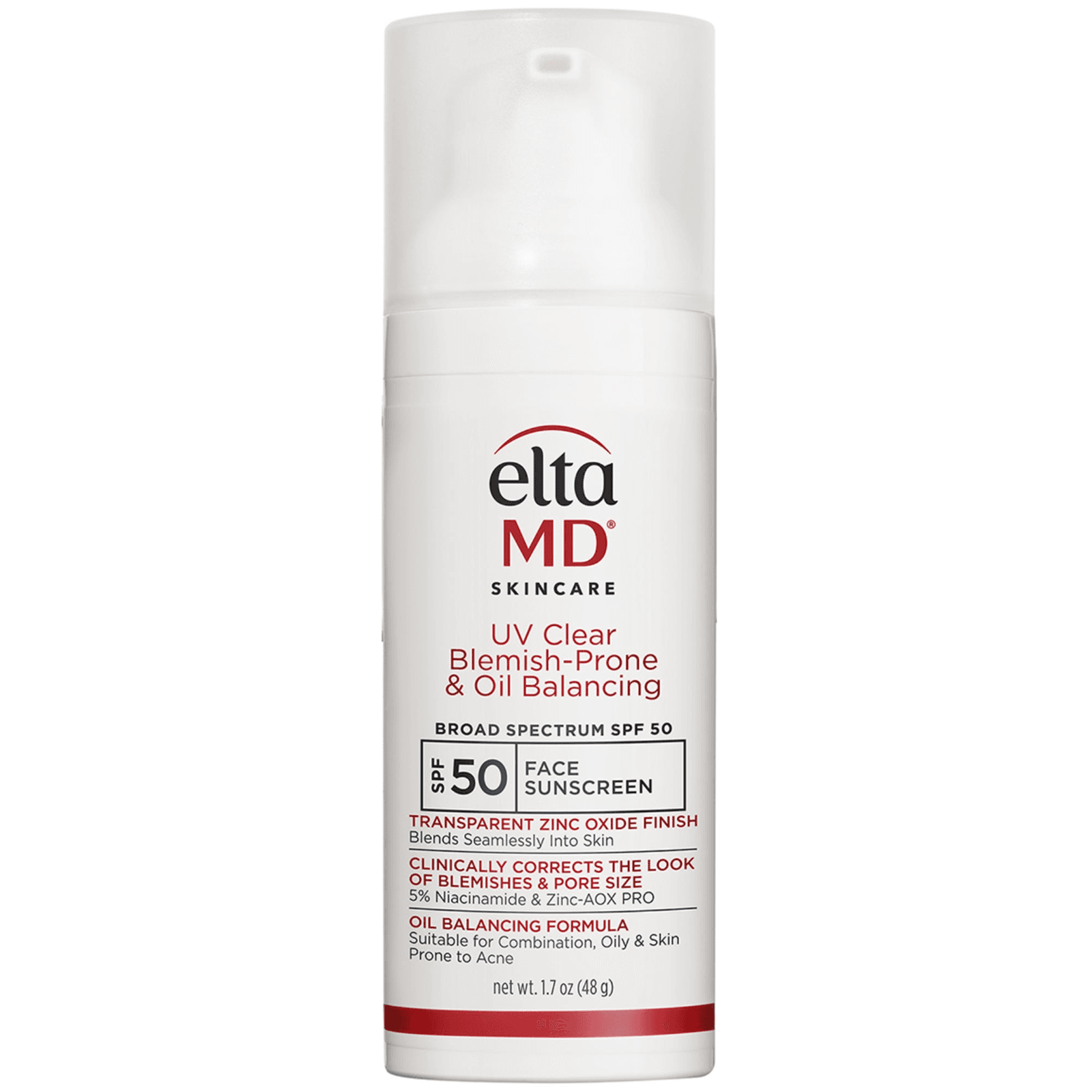 EltaMD UV Clear Blemish-Prone & Oil Balancing SPF 50Best overall | Zinc oxide 11% and octinoxate 3.5% | Mineral and chemical | 50 | Untinted | No | None listed | Non-comedogenic, won't clog pores | |
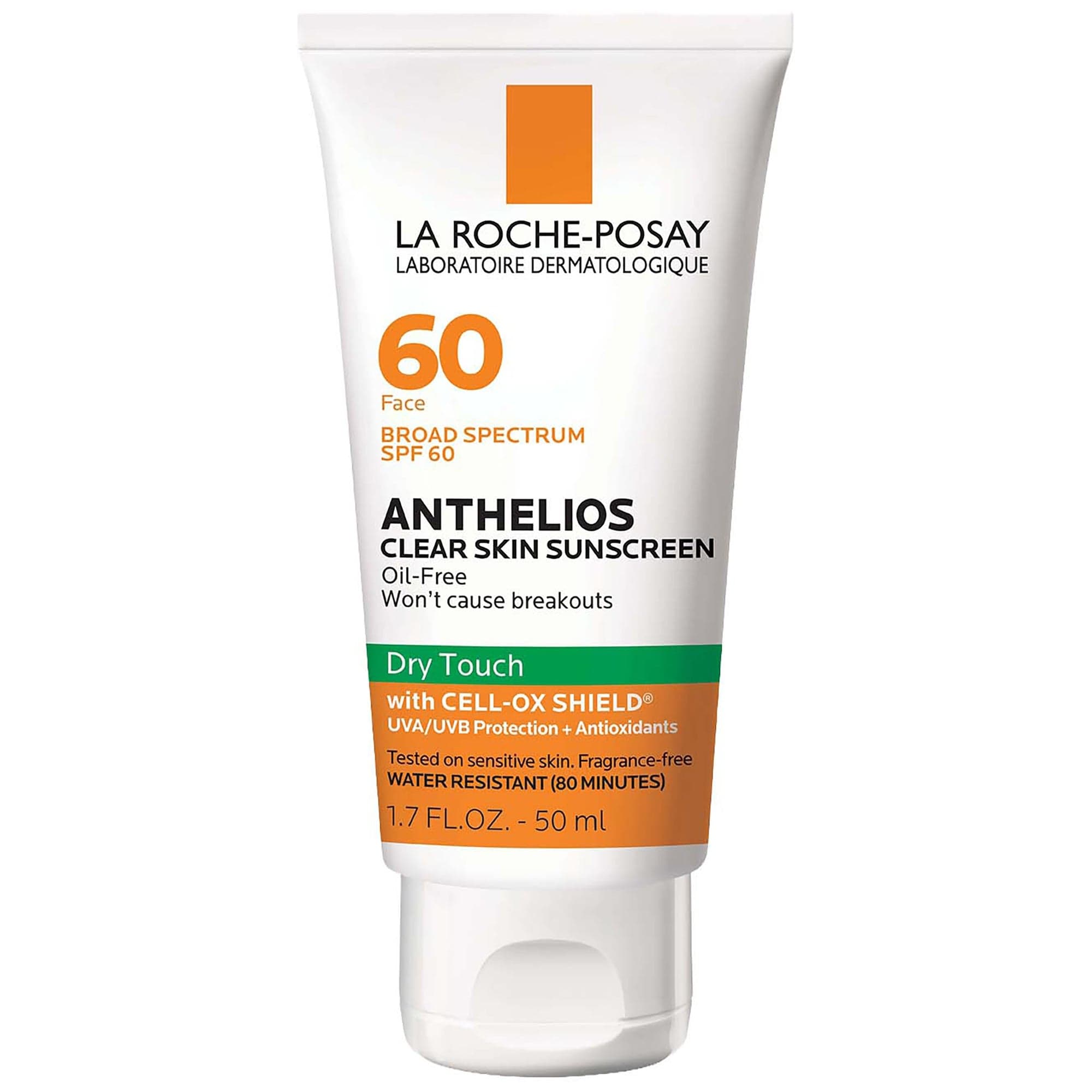 La Roche-Posay Anthelios Clear Skin Dry Touch Sunscreen SPF 60Best sunscreen for oily skin | Avobenzone 3%, homosalate 15%, octisalate 5% and octocrylene 7% | Chemical only | 60 | Untinted | 80 minutes | Silica, perlite, nylon-12 and methyl methacrylate crosspolymer | Non comedogenic, won't clog pores | |
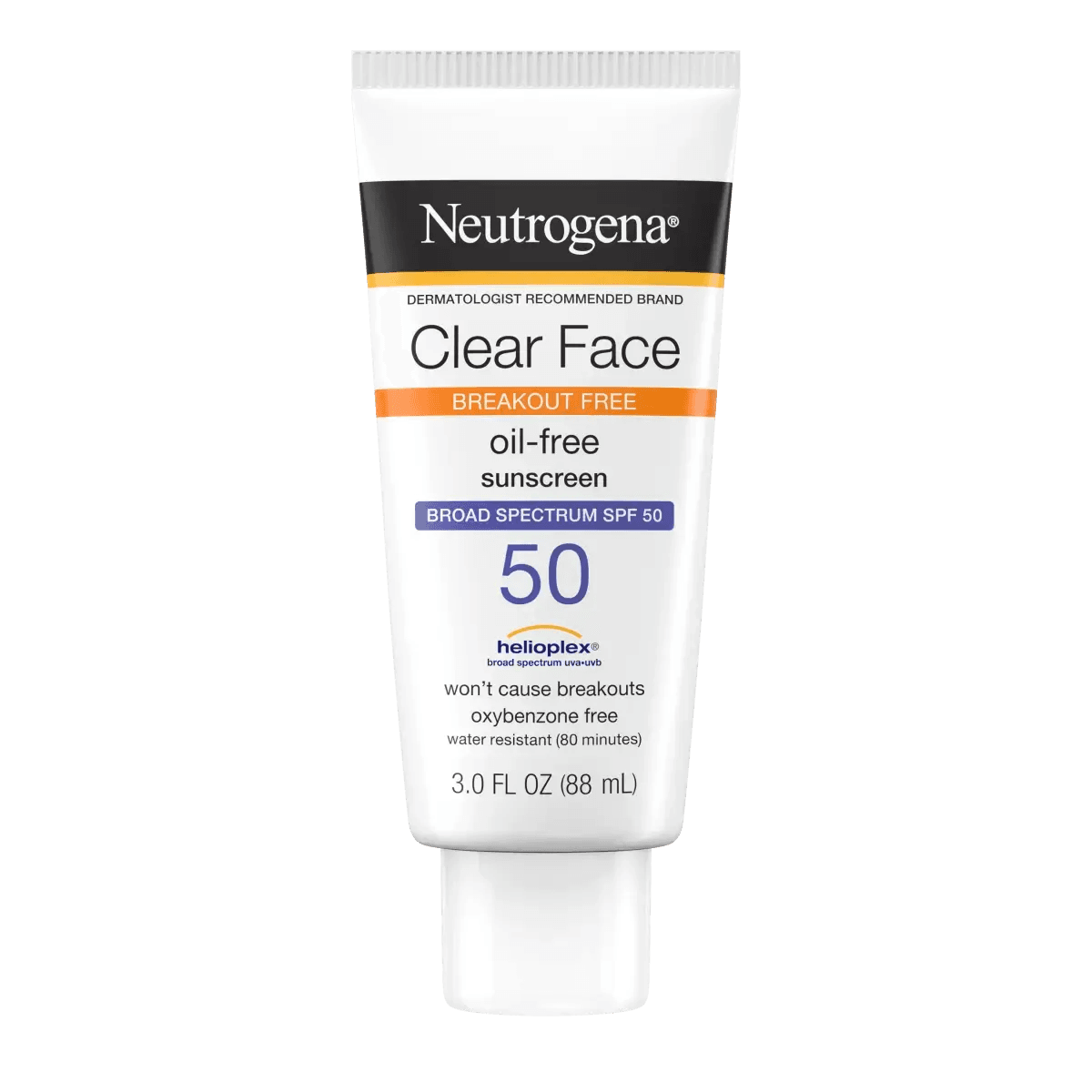 Neutrogena Clear Face Oil-Free Sunscreen SPF 50Best drugstore sunscreen for acne-prone skin | Avobenzone 3%, homosalate 10%, octisalate 5% and octocrylene 10% | Chemical only | 50 | Untinted | 80 minutes | Silica and aluminum starch octenylsuccinate | Won't cause breakouts | |
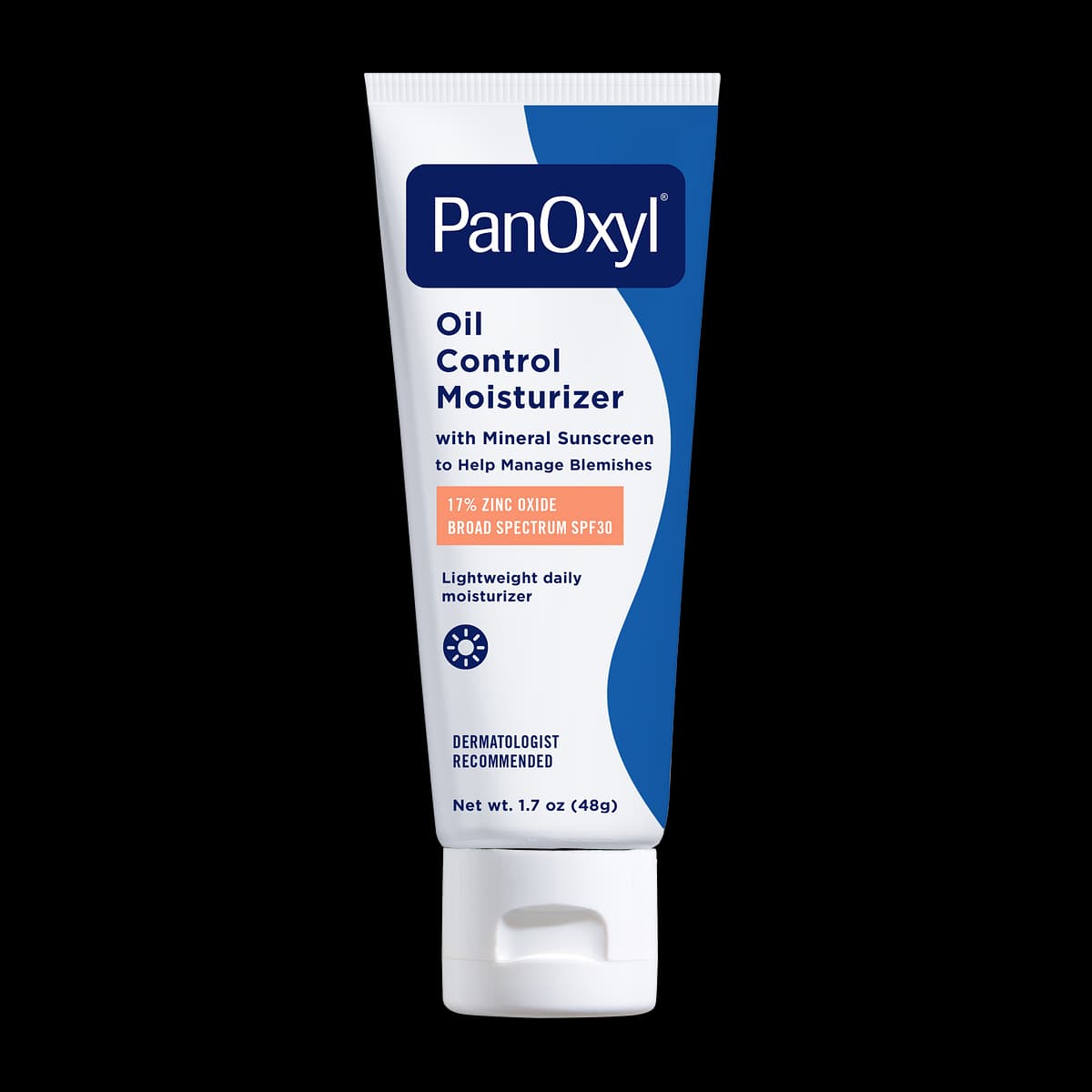 PanOxyl Oil Control Moisturizer with Mineral Sunscreen SPF 30Best mineral sunscreen for acne-prone skin | Zinc oxide 17% | Mineral only | 30 | Untinted | No | Polymethylsilsesquioxane and tapioca starch | Won't clog pores | |
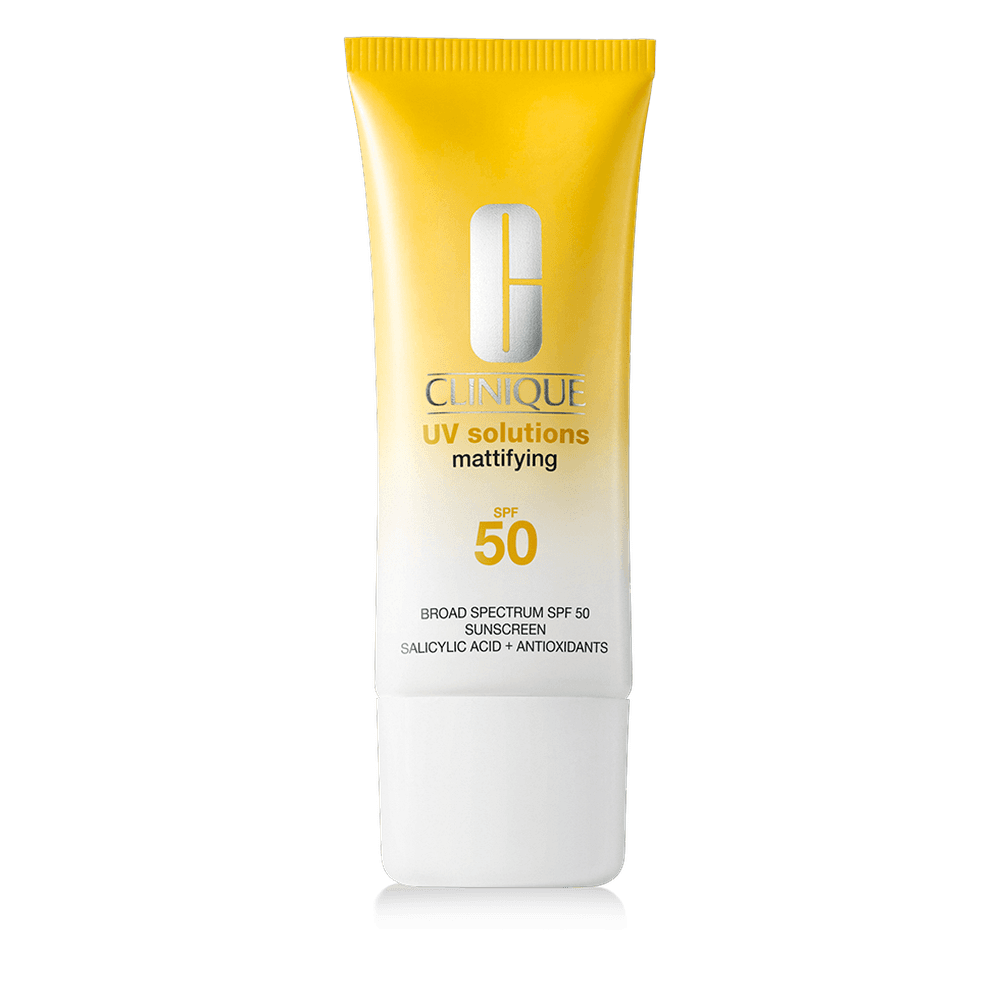 Clinique UV Solutions Mattifying Sunscreen SPF 50Best matte sunscreen under makeup | Avobenzone 3%, homosalate 7%, octisalate 4.5% and octocrylene 7% | Chemical only | 50 | Untinted | No | Silica | Non-pore clogging | |
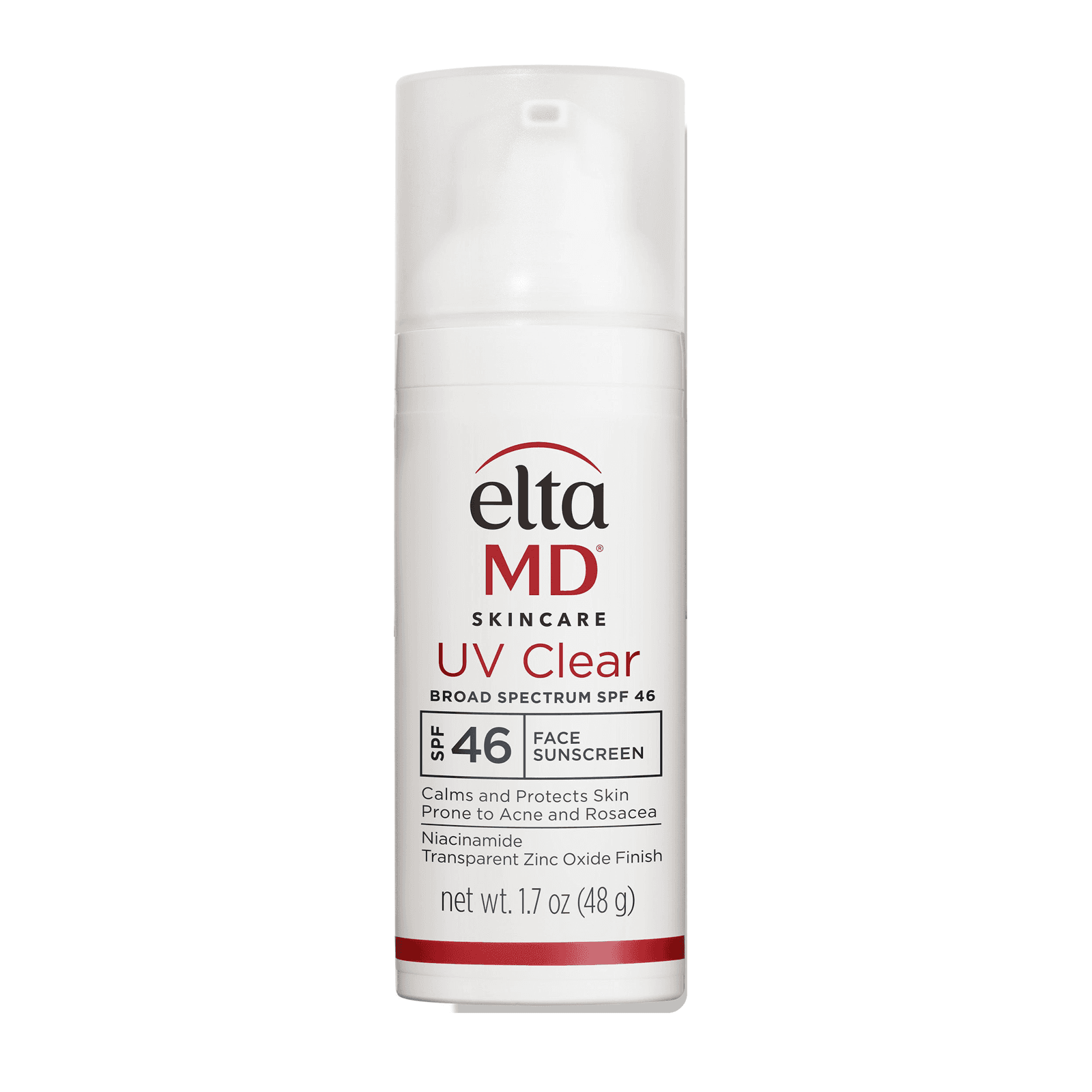 EltaMD UV Clear SPF 46Best sunscreen for acne-prone skin with redness | Zinc oxide 9% and octinoxate 7.5% | Mineral and chemical | 46 | Untinted | No | None listed | Non-comedogenic | |
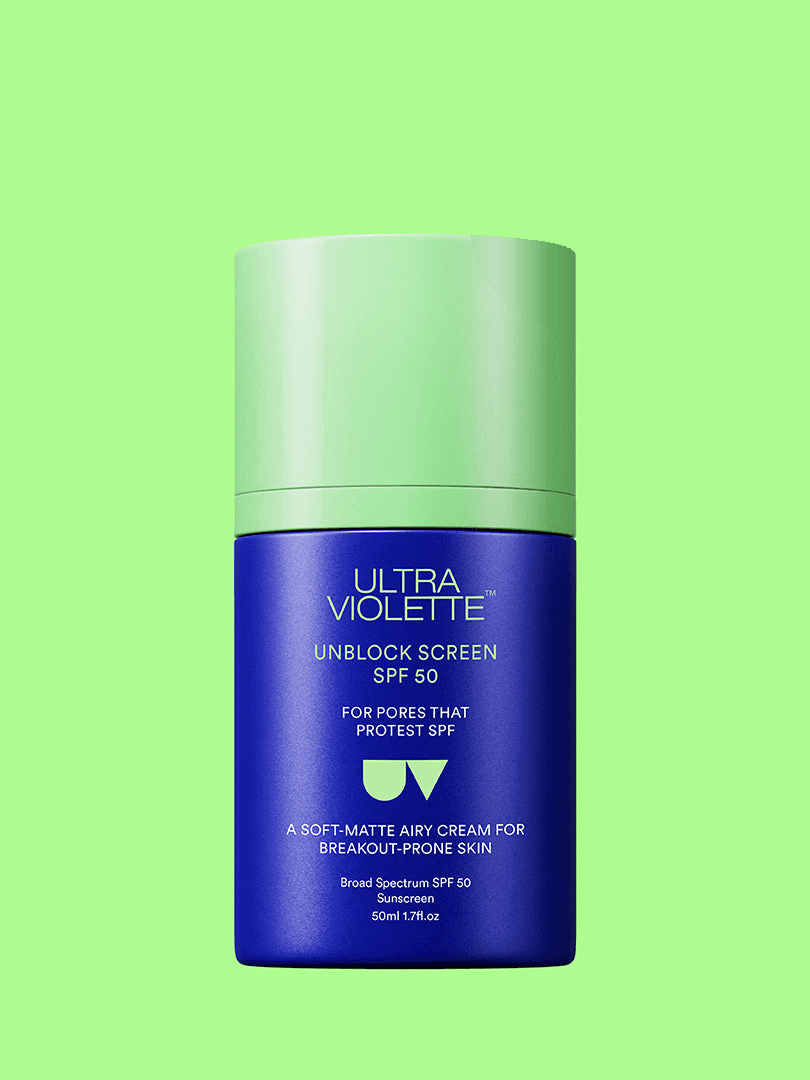 Ultra Violette Unblock Screen SPF 50Best sunscreen for hyperpigmentation after acne | Zinc oxide 10%, octocrylene 6% and bemotrizinol 3% | Mineral and chemical | 50 | Tinted | No | Silica | For pores that protest SPF (Ultra Violette's site: non-comedogenic) | No store link |
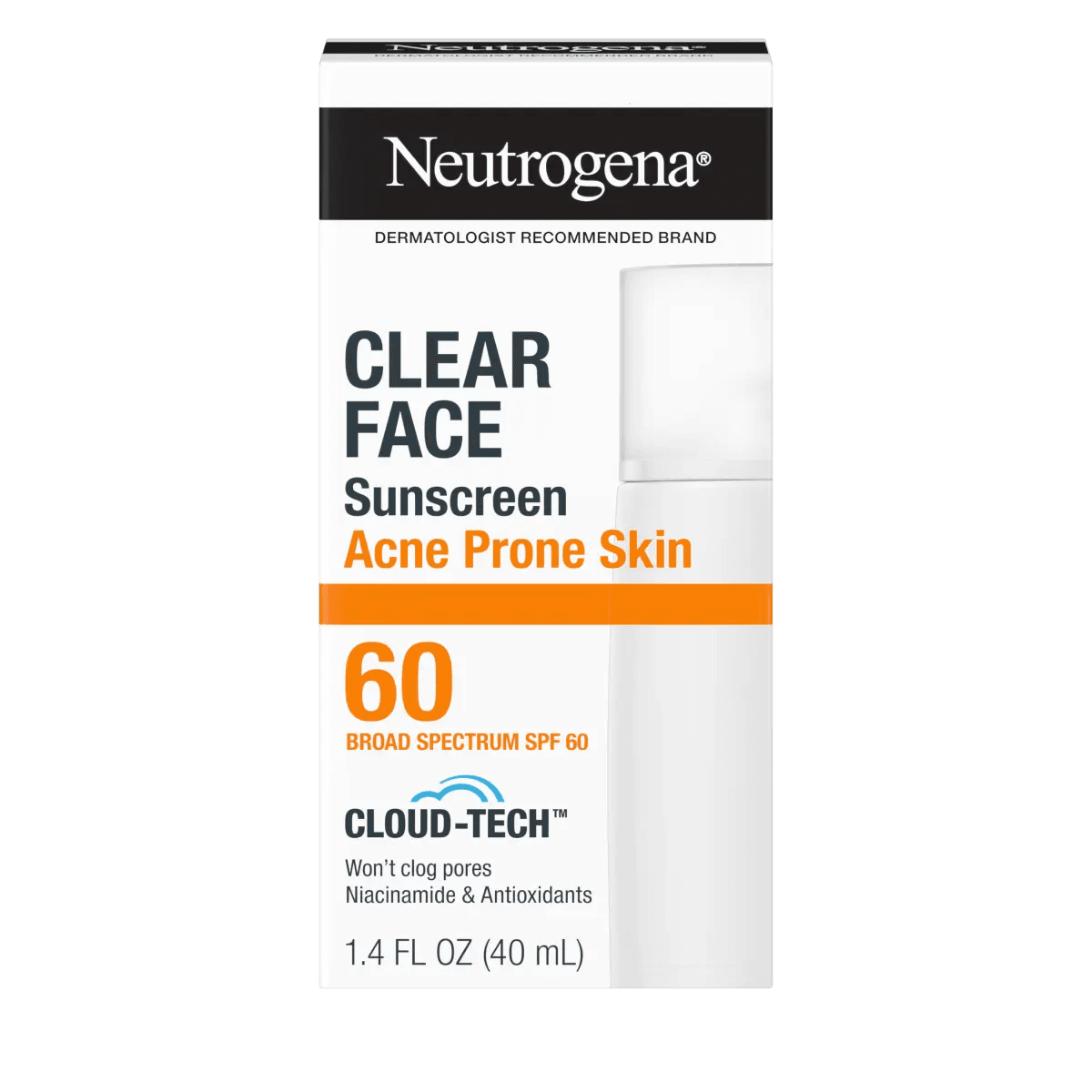 Neutrogena Clear Face Sunscreen Acne-Prone Skin SPF 60 with BEMTBest bemotrizinol sunscreen for acne-prone skin | Avobenzone 3%, homosalate 15%, octisalate 5% and bemotrizinol 6% | Chemical only | 60 | Untinted | No | Silica and aluminum starch octenylsuccinate | Won't clog pores |
What to look for in an “acne-safe” sunscreen: six things to check on the label
- “Non-comedogenic” or “won’t clog pores” on the pack. That is the AAD’s advice for acne-prone and for oily skin alike, repeated on its acne pages (AAD, AAD). It is the brand’s claim, not a tested standard: see what the words mean.
- No oils or butters in the inactive list. The AAD’s oily-skin page says not to use sunscreens that contain fragrance or oils (AAD), and the one study we found of sunscreens and clogged pores, in rabbits’ ears in 1982, blamed the base rather than the UV filters, without naming which base ingredients (Mills and Kligman 1982, rabbit study). The “Oils and butters” row on our cards names plant oils and butters, mineral oil, squalane and isopropyl esters. A sunscreen sold only as a drug lists its inactive ingredients alphabetically (21 CFR 201.66), so a position tells you nothing there; three of the 18 labels on this page are alphabetical.
- No fragrance. The same AAD page says so. In a 2026 study of 176 best-selling US sunscreens, 44% listed fragrance among their inactive ingredients (Levin 2026). None of our picks lists it.
- Oil absorbers, if you shine. Silica, perlite, nylon-12 and starches soak up oil already on your skin; most over-the-counter oil control works this way, rather than by changing how much oil you make (Draelos 2006). La Roche-Posay Anthelios Clear Skin SPF 60 lists four, Neutrogena Clear Face SPF 50 two.
- Broad Spectrum SPF 30 or higher, and water resistant if you sweat. The AAD’s three essentials for any sunscreen are SPF 30 or higher, broad spectrum and water resistance (AAD), and its acne page repeats them (AAD). A label may claim only 40 or 80 minutes, after testing (21 CFR 201.327). Only two of our picks are water resistant; the rest say on the label to use a water-resistant sunscreen if you swim or sweat.
- No drying alcohol high on the list. We left out Eucerin Clear Skin SPF 50 and Bioré UV Aqua Rich SPF 50, which both list alcohol denat. 2nd. On a label, “alcohol” means ethyl alcohol; fatty alcohols such as cetyl alcohol are a different thing (FDA). This is our screen, not an AAD rule.
What “non-comedogenic” and “oil-free” mean on a sunscreen
Neither word has a legal definition. An FDA spokesperson told SELF there are no federal definitions or FDA cosmetic rules for “noncomedogenic” (SELF, 2019); a systematic review found “non-comedogenic” and “oil-free” regulated by no governing body (Boozalis 2018); and the FDA keeps no list of approved cosmetic claims (FDA). The federal sunscreen labeling rule sets the words for SPF, broad spectrum and water resistance, and never mentions either one (21 CFR 201.327).
A brand can back the claim in one of two ways, say two authors from a contract lab that runs these tests: a patch test on people’s backs, the cheaper method, or a clinical trial, which they call the gold standard (Weiss and Caswell 2017). No rule requires either: the claim is regulated by no governing body (Boozalis 2018). Two of our picks cite their own studies, for other claims: EltaMD, 12 weeks and 43 people, for visible oil and shine (EltaMD), and Ultra Violette, 28 days and 21 people, for blemishes and shine (Ultra Violette). Both are the brands’ own.
Ingredient lists are a weaker guide than they look. Lists of “pore-clogging ingredients” began with animal tests of raw ingredients (Draelos and DiNardo 2006), such as Fulton’s rabbit-ear list (Fulton 1984); the researchers behind the human back test found rabbit skin more sensitive than ours (Mills and Kligman 1982, human model); and in a back test on six comedone-prone people, finished products with a “comedogenic” ingredient were not necessarily comedogenic (Draelos and DiNardo 2006).
“Oil-free” in practice means no mineral or plant oil (Chularojanamontri 2014), and nothing checks it. In our catalog, 4 of 20 face sunscreens with “oil-free” in the name list an oil, butter, squalane or isopropyl ester. On this page, the current carton of EltaMD UV Clear SPF 46 dropped “oil-free”, though EltaMD’s site and its Amazon listing still say it, and Ultra Violette says Unblock is not oil-free (Ultra Violette), though its list names no oil. The AAD still says to look for the words (AAD): they are a quick first filter, and the list is the second. More in our oily-skin moisturizer guide.
Can sunscreen cause acne or clog pores?
Some may, but the evidence is thin. The only study we found of sunscreens and pore clogging is from 1982, in rabbits’ ears: 14 of 29 sunscreens of the day clogged pores, more so with UV light, and the base, not the UV filters, seemed to be the cause (Mills and Kligman 1982, rabbit study). Rabbit ears over-react compared with human skin (Mills and Kligman 1982, human model), and 1982 formulas are not today’s.
No trial we found compares a sunscreen labeled non-comedogenic with an ordinary one for breakouts. A 2023 review, by authors including two from the sunscreen maker ISDIN, found only four relevant studies of sun protection in acne at all (Piquero-Casals 2023). So read the base: of the 18 labels on this page, four list an oil or butter (Supergoop! Unseen SPF 50, Hero Force Shield Superlight SPF 30, Black Girl Sunscreen Make It Matte SPF 45 and Murad Superactive SPF 50), and none of our picks does.
On Reddit, breakouts are the complaint people raise most. In the 37 threads we read, breakouts were the complaint in 101 of the 1,015 verdicts people gave on a sunscreen or brand, greasiness or shine in 62 and white cast in 32, as in a busy r/SkincareAddiction thread. That is community opinion, not evidence about any product.
Mineral or chemical sunscreen for acne-prone and oily skin?
The AAD gives two instructions. Its sunscreen guide says only to look for “non-comedogenic” or “won’t clog pores”, for acne-prone and oily skin alike (AAD). Its oily-skin page says that to prevent breakouts, look for sunscreens with zinc oxide and titanium dioxide, and avoid ones with fragrance or oils (AAD). Neither cites a study for this advice: the sunscreen guide’s six references are about sun protection in general, and the oily-skin page lists none.
None of the 18 labels on this page pairs zinc oxide with titanium dioxide. The closest is PanOxyl Oil Control SPF 30: 17% zinc oxide alone, with no oil and no fragrance. One exact match is La Roche-Posay Anthelios Mineral Zinc Oxide SPF 50: 5% zinc oxide and 6% titanium dioxide, with no fragrance and no oils on the label we read on October 10, 2026. It is already our pick for oily skin in our mineral sunscreen and sensitive-skin sunscreen picks, so it has no card here. Another, tinted, is Supergoop! Mineral Mattescreen SPF 40: 17.68% zinc oxide and 1.33% titanium dioxide, with no fragrance and no oil by our test, though caprylic/capric triglyceride is 3rd on the label we read on October 3, 2026. It is our tinted sunscreen pick for oily skin.
Our picks split three ways: one mineral only (PanOxyl Oil Control SPF 30), three that pair zinc oxide with chemical filters (EltaMD UV Clear Blemish-Prone SPF 50, EltaMD UV Clear SPF 46 and Ultra Violette Unblock Screen SPF 50) and four chemical only (La Roche-Posay Anthelios Clear Skin SPF 60, Neutrogena Clear Face SPF 50, Clinique UV Solutions Mattifying SPF 50 and Neutrogena Clear Face SPF 60 with BEMT). If you have sensitive skin, the AAD’s retinoid page suggests a physical sunscreen with titanium dioxide and/or zinc oxide (AAD). Our guide to sunscreen filters covers each one.
Non-greasy sunscreen for oily skin: oil absorbers, finish and shine by noon
Oil absorbers only soak up oil already on your skin (see what to look for). Skin wiped clean is back at its usual oiliness within about two hours (Rode 2000), which may be why a matte finish fades by midday. Oil output also rises in spring, summer and humid climates (Endly and Miller 2017).
Niacinamide is the other route. At 2%, it lowered oil output over four weeks against a placebo in a trial of 100 Japanese adults, and lowered surface oil but not output over six weeks in 30 white adults (Draelos 2006). The “oil balancing” claim on EltaMD UV Clear Blemish-Prone SPF 50 rests on EltaMD’s own study (EltaMD), and its list has niacinamide, not a powder. For a serum, see our niacinamide serum picks.
Does skin oil make sunscreen wear off? No study we found has measured it. Sweat does: on a sweating skin model, sweat thinned the sunscreen film and moved it around, and a thicker layer kept more protection (Keshavarzi 2021; four authors work for Riemann, a sunscreen maker). So use enough, reapply at least every two hours (FDA), and reapply after 40 or 80 minutes of swimming or sweating if the label claims water resistance (21 CFR 201.327).
For shine at midday, the AAD suggests blotting papers, pressed on for a few seconds rather than rubbed. The same page says an SPF 30 moisturizer can do both jobs, but people miss more of their face with an SPF moisturizer than with a sunscreen (Lourenco 2019). Our oily-skin moisturizers with SPF include Cetaphil Oil Absorbing Moisturizer SPF 30 and Differin Oil Absorbing Moisturizer SPF 30, which share the same Drug Facts.
Sunscreen for acne dark spots and hyperpigmentation
The AAD’s advice, written for darker skin tones: treat the acne first, and most dark spots then fade on their own, though it may take a long time. To help prevent and clear them, wear a tinted sunscreen with iron oxide that blends with your skin tone. It should be SPF 30 or higher, broad spectrum and water resistant, and non-comedogenic if your skin is oily. Reapply every two hours and after swimming or sweating.
Why the tint: in a lamp study of 20 people with skin types IV to VI (brown to dark skin), visible light darkened skin more, and for longer, than long-wave UVA (Mahmoud 2010; its trial registration lists Johnson & Johnson, then Neutrogena’s owner, as a collaborator: ClinicalTrials.gov), and tinted sunscreens with iron oxides block visible light that ordinary UV filters miss (Lyons 2021, a review with an ISDIN co-author). In a 20-person trial run by ISDIN, a daily sunscreen with sclareolide and niacinamide kept test sites on the back from darkening after UV and visible light (Passeron 2026); those were sites darkened on purpose, not acne marks.
Our pick, Ultra Violette Unblock Screen SPF 50, lists three iron oxides and no fragrance, but it is not water resistant and comes in one tint. For more shades, see our tinted sunscreen picks, with a pick for melasma and dark spots and one for dark skin tones. A retinoid or azelaic acid can also lighten dark spots after acne (AAD); for serums, see our dark spot corrector picks. Raised or pitted scars are a different problem, for a dermatologist (AAD).
Sunscreen when you use tretinoin, adapalene, benzoyl peroxide or doxycycline
Some acne medicines can make your skin very sensitive to UV light, the AAD says, and it advises a broad-spectrum, water-resistant SPF 30 or higher that says non-comedogenic or won’t clog pores. The drug labels also warn about the sun:
- Adapalene: Differin Gel’s Drug Facts say to limit sun exposure, including tanning beds, and to use sunscreen when going outdoors (Differin label). More in our Differin Gel review.
- Benzoyl peroxide: the federal acne-drug rule makes its labels say to avoid unnecessary sun exposure and use a sunscreen, and leave-on products say to apply sunscreen after it if you go outside (21 CFR 333.350). See our PanOxyl wash review and acne face wash picks.
- Tretinoin and other retinoids: they can make skin more sensitive to the sun, so the dermatologist the AAD quotes advises using them only at night, with sun protection by day (AAD). For a retinoid plan, the AAD lists a non-comedogenic, broad-spectrum, water-resistant SPF 30 or higher on all uncovered skin (AAD).
- Doxycycline: its label reports an exaggerated sunburn reaction with tetracyclines, says to avoid excessive sunlight or artificial UV light, and says “Sunscreen or sunblock should be considered” (Doryx MPC label).
Of our picks, only La Roche-Posay Anthelios Clear Skin SPF 60 prints the AAD’s words and is water resistant; Neutrogena Clear Face SPF 50 is water resistant but says “won’t cause breakouts”. If your skin is sensitive, PanOxyl Oil Control SPF 30, zinc oxide alone, fits the advice on the AAD’s retinoid page. One person on tretinoin in an r/acne thread says three mineral sunscreens broke them out, and that their skin is sensitive to the sun; that is one person’s experience, not evidence.
If every sunscreen breaks you out
You are not alone: one Reddit thread is titled “Every SPF I try causes acne. What to do?!”. Its top reply asks whether the poster double cleanses, a commenter’s idea rather than a tested fix; if you want to try it, see our oil cleanser picks. Steps to try (none has been tested as a fix for sunscreen breakouts):
- Patch test first, for a reaction. Twice a day for 7 to 10 days on a small spot, such as the bend of the elbow (AAD). It shows redness, itching or swelling, not clogged pores.
- Change one product at a time, so you can tell which one did it.
- Check the “Oils and butters” row on each card, and pick a list with none.
- Wash it off at night with a gentle cleanser; the AAD says to wash twice a day and after heavy sweating (AAD). See our acne face wash picks. For a waterproof sunscreen, an oil cleanser first takes off more of it (see our oil cleanser guide).
- Lean on shade and clothing on bad days. Shade, a wide-brimmed hat and clothing protect skin without putting anything on it; the AAD lists them with sunscreen, not instead of it (AAD), so keep sunscreen on any skin they leave bare.
- See a dermatologist if acne will not clear. The AAD says to give a treatment at least 4 weeks, and that clearing can take 2 to 3 months or longer (AAD).
How to use sunscreen on acne-prone and oily skin
- At least a teaspoon for the face, about the length of your index and middle fingers, 15 minutes before you go out (AAD).
- Last step of your morning skincare, after a leave-on benzoyl peroxide product, as its label directs (21 CFR 333.350); see the order to apply skincare in.
- Under makeup, the sunscreen has to do the job alone: layered SPFs do not add up (Skin Cancer Foundation). Clinique says to apply its Mattifying SPF 50 before makeup, and Neutrogena’s BEMT carton says “makeup wear”.
- Reapply every two hours outdoors, and after swimming or sweating (AAD). Only two of our picks are water resistant: La Roche-Posay Anthelios Clear Skin SPF 60 (80 minutes) and Neutrogena Clear Face SPF 50 (80 minutes).
- Shine at noon: blot, pressing rather than rubbing (AAD).
How we picked, and why you can trust it
We read the guides Google shows on page 1 for “best sunscreen for acne prone skin”, “best sunscreen for oily skin” and four close searches: 12 with picks (Glamour’s acne and oily lists, Teen Vogue, Allure, Byrdie, ELLE’s oily and non-comedogenic lists, NBC Select, Cosmopolitan’s list as reprinted by a dermatology practice, Curology, Into The Gloss and a personal blog) and two without (a sunscreen brand’s blog and a dermatology practice’s page). We also read the Ulta, Amazon, Sephora, Bluemercury and Art of Skin Care pages for the category on November 3, 2026, and 1,454 comments in 37 Reddit threads. Then we read the current US label of 21 sunscreens: the Drug Facts on DailyMed, from the carton image where the typed text differed, or Shiseido’s US page for its SPF 40, which DailyMed does not list yet. We kept Broad Spectrum SPF 30 or higher with no plant oil, butter, mineral oil, squalane, isopropyl ester, fragrance or drying alcohol, and a pore or breakout claim on the pack or the brand’s US page, then chose one for each skin need. Cruelty-free status comes from the Leaping Bunny and Cruelty Free International directories (EltaMD, La Roche-Posay, Neutrogena, PanOxyl and Clinique on October 10, 2026 and Ultra Violette on November 3, 2026); none of our picks’ brands is certified.
Several guides, and one store listing, do not match the US label:
- Teen Vogue lists La Roche-Posay Clear Skin’s active ingredients as perlite, silica and thermal spring water. Its US actives are 3% avobenzone, 15% homosalate, 5% octisalate and 7% octocrylene, and silica (2nd) and perlite (10th) are inactive ingredients.
- Teen Vogue gives Eucerin Clear Skin’s active ingredient as “5 AOX Shield”, a slogan on its carton. Its actives are 3% avobenzone, 10% homosalate, 5% octisalate and 10% octocrylene.
- Teen Vogue lists niacinamide as an active ingredient in EltaMD UV Clear. Its actives are 9% zinc oxide and 7.5% octinoxate, and niacinamide is the 3rd inactive ingredient.
- Glamour gives Hero Force Shield Superlight as 3 fl oz and water resistant. The US carton is 1.69 fl oz and claims no water resistance.
- Byrdie’s acne guide (updated May 29, 2026) lists Supergoop Unseen as SPF 40. The US product sold now is SPF 50, which replaced it in 2024.
- ELLE’s non-comedogenic guide heads an entry “Supergoop! Unseen Sunscreen SPF 30” under a mineral award, though its text describes Supergoop’s Mineral Sheerscreen. Unseen’s US label is SPF 50: 3% avobenzone, 7% homosalate, 5% octisalate and 9% octocrylene, with no zinc oxide.
- Allure’s best overall, “Shiseido Urban Environment Oil-Free Mineral Sunscreen SPF 42”, was not mineral only: that pack’s Drug Facts on DailyMed paired 15.5% zinc oxide with 1.0% ensulizole, 15.0% homosalate and 5.0% octisalate. The pack sold now, Oil-Control Sunscreen SPF 40, is the same kind of hybrid (15.5% zinc oxide, 13.6% homosalate, 5% octisalate and 1.1% ensulizole), no longer says oil-free, and lists SD Alcohol 40-B 4th and fragrance.
- Amazon’s listing for Neutrogena’s Clear Face SPF 60 with BEMT says water resistant (80 minutes). The US carton claims none, and says to use a water-resistant sunscreen if you swim or sweat.
For more zinc oxide options, see our mineral sunscreen picks; for reactive skin, our sensitive-skin sunscreen picks; for color, our tinted sunscreen picks; for a moisturizer underneath, our moisturizers for oily skin; and for a Korean formula, our lightweight Korean sun gel pick, which lists no oil, butter or fragrance.
- Every ingredient position, count and fragrance or alcohol flag on a product card is generated from its US ingredient list, not typed by hand.
- Every health claim links to its source, such as the AAD, the FDA, a Drug Facts label or a published study.
- No brand pays, sends free products or buys ads to be on a list, and commission never decides a pick.
- We did not test these on skin or run a panel, and we say so on every post.
Our full method explains what we check and why.
Also considered
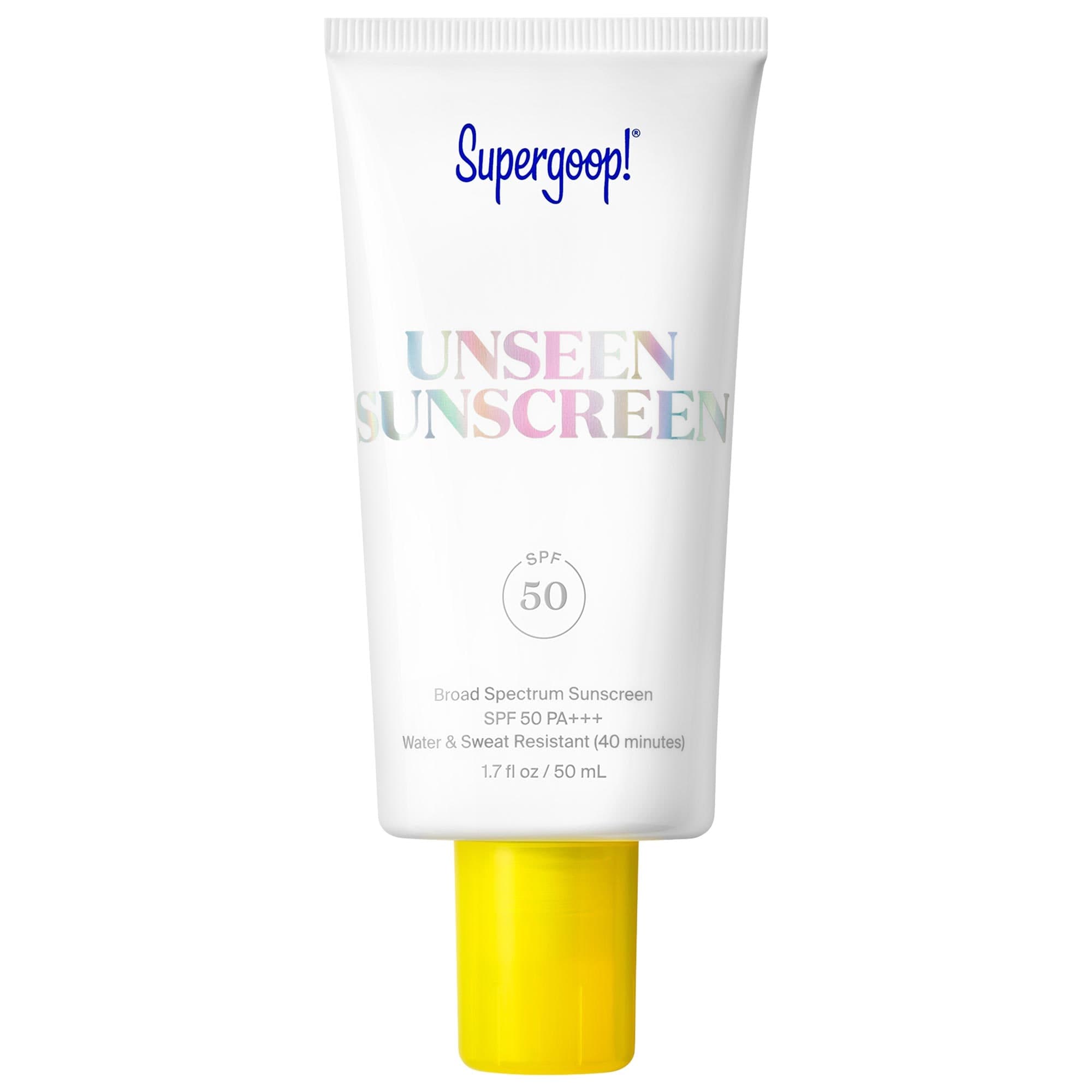
Supergoop! Unseen Sunscreen SPF 50
Five page-1 pages name it, and it tops Ulta’s oily-skin page. Its carton says non-comedogenic and fragrance-free, and it is water resistant for 40 minutes. But it lists shea butter (7th), with caprylic/capric triglyceride, meadowfoam estolide and jojoba esters, and in the Reddit threads we read, 7 of the 21 people who gave a verdict on it said it broke them out, four of them in 2025 or 2026, after the SPF 50 replaced the SPF 40 (an r/SkincareAddiction thread). Supergoop! is Leaping Bunny certified.
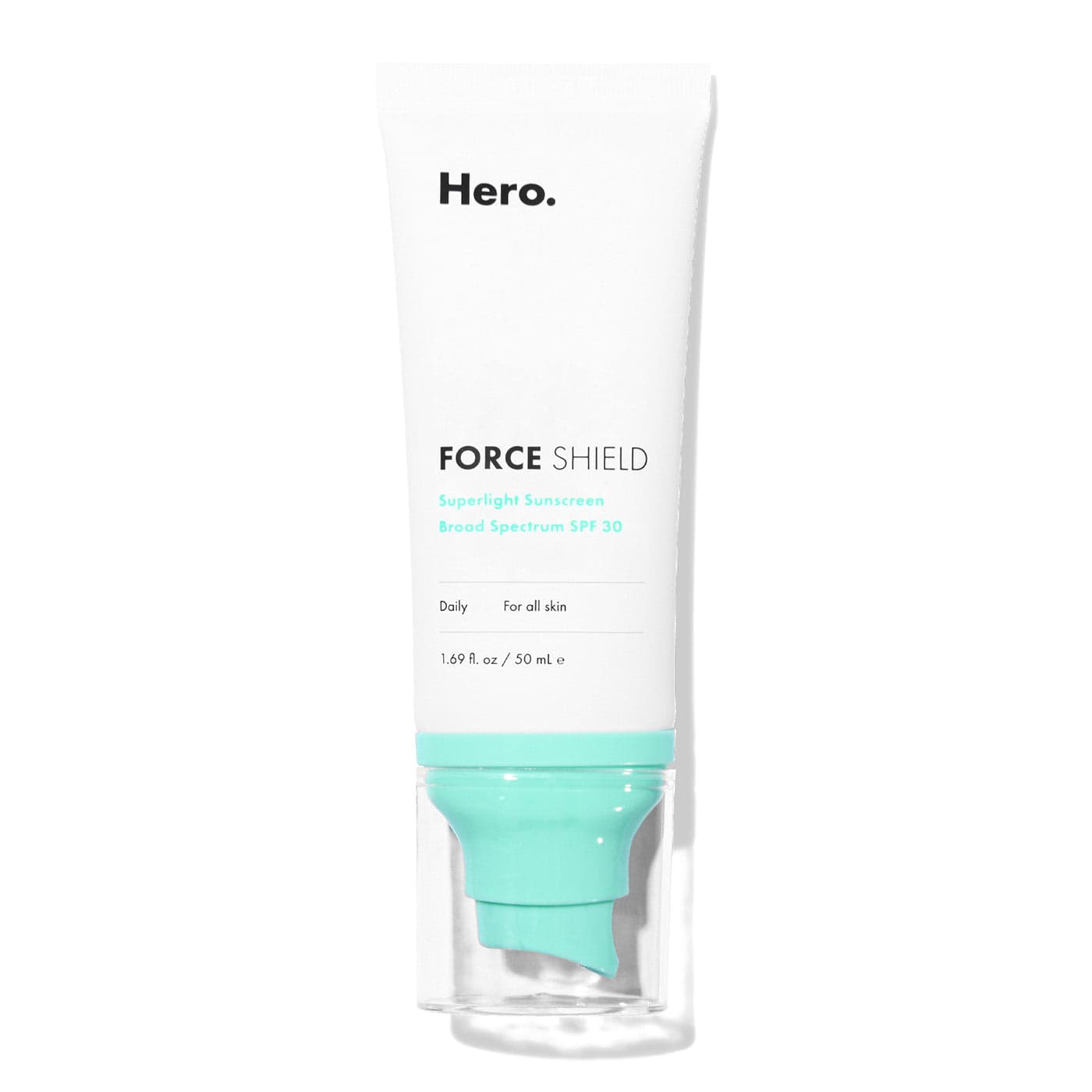
Hero Cosmetics Force Shield Superlight Sunscreen SPF 30
Four page-1 pages name it, Glamour as its best for redness. It is 17.53% zinc oxide alone, and its carton promises a light-green tint for redness and says non-comedogenic and won’t clog pores. But caprylic/capric triglyceride is 2nd on the list, it lists raspberry seed oil and moringa oleifera seed oil, and it is not water resistant, though Glamour says it is.
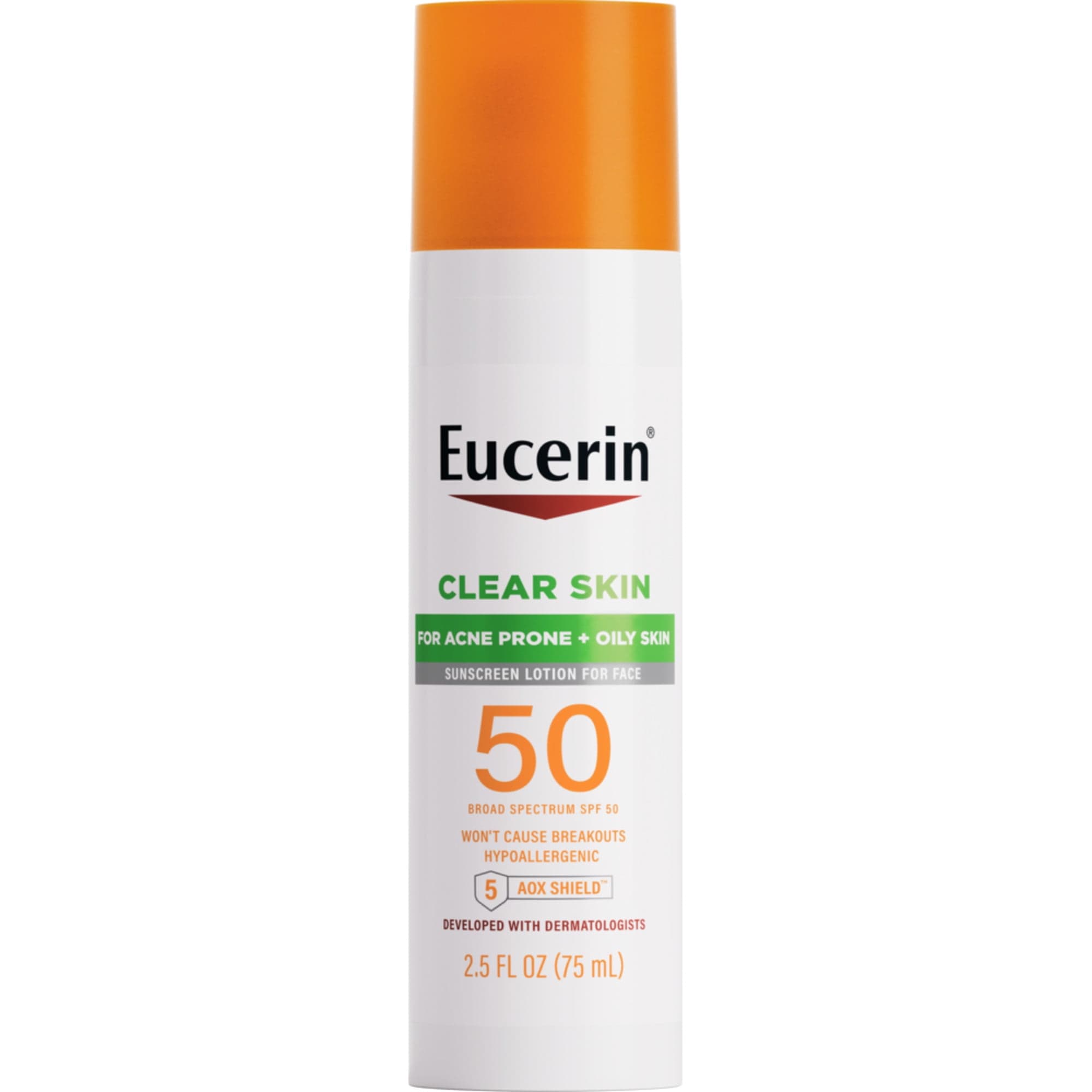
Eucerin Clear Skin SPF 50 Face Sunscreen
Teen Vogue picks it, and its carton says oil free, fragrance free and won’t clog pores, with silica 4th and no oil or butter. But alcohol denat. is 2nd of 32, and it is not water resistant, so Neutrogena Clear Face SPF 50 beats it. It was sold until recently as Eucerin Oil Control SPF 50; Eucerin says the formula is the same.
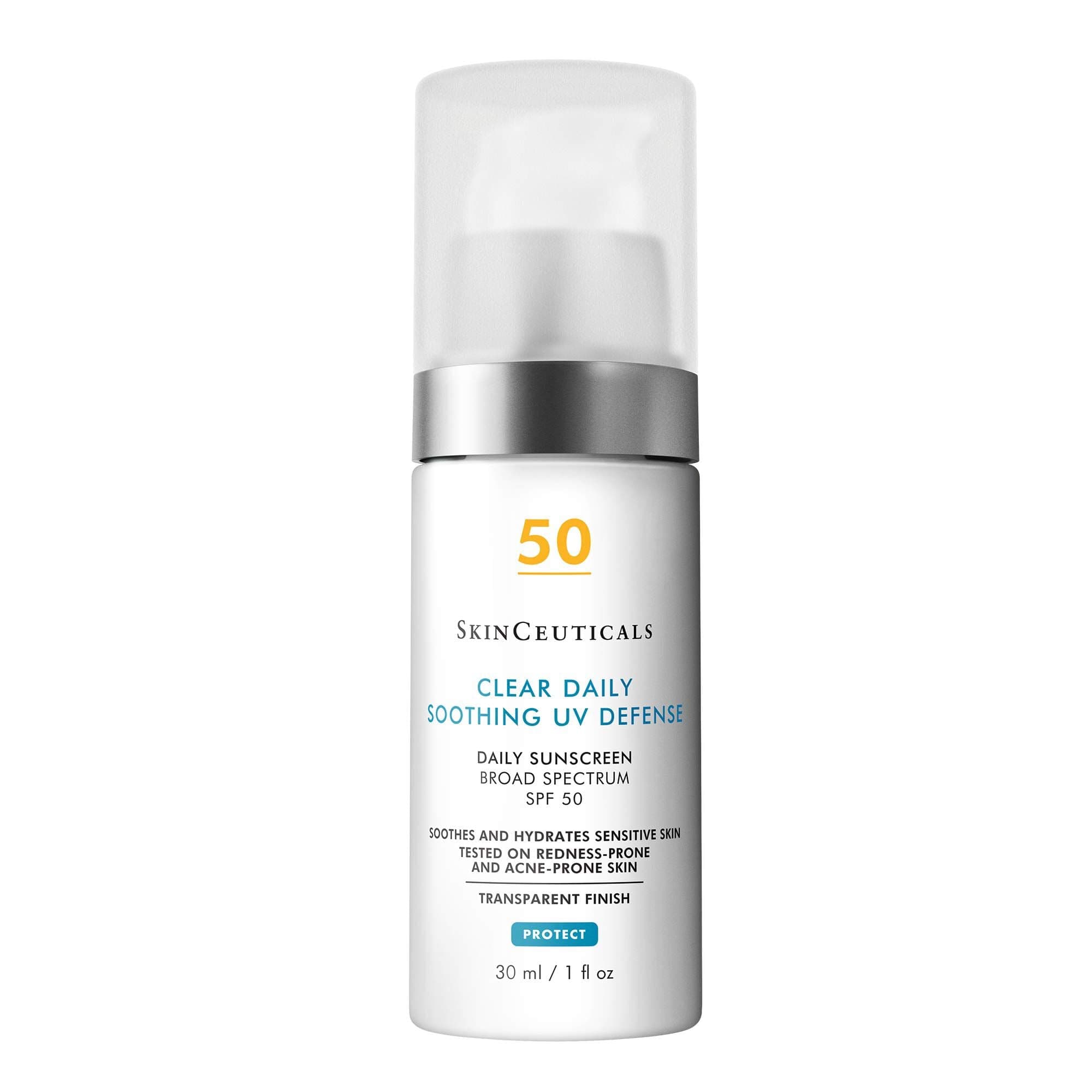
SkinCeuticals Clear Daily Soothing UV Defense SPF 50
Allure’s pick for acne-prone skin, and its carton says it was tested on redness-prone and acne-prone skin, and its list has no fragrance. But it pairs 7% zinc oxide with three chemical filters, lists coco-caprylate/caprate 3rd, has no oil absorber, and comes in a 1 fl oz bottle. EltaMD UV Clear SPF 46 beats it for redness with a shorter list: 16 inactive ingredients against 27.
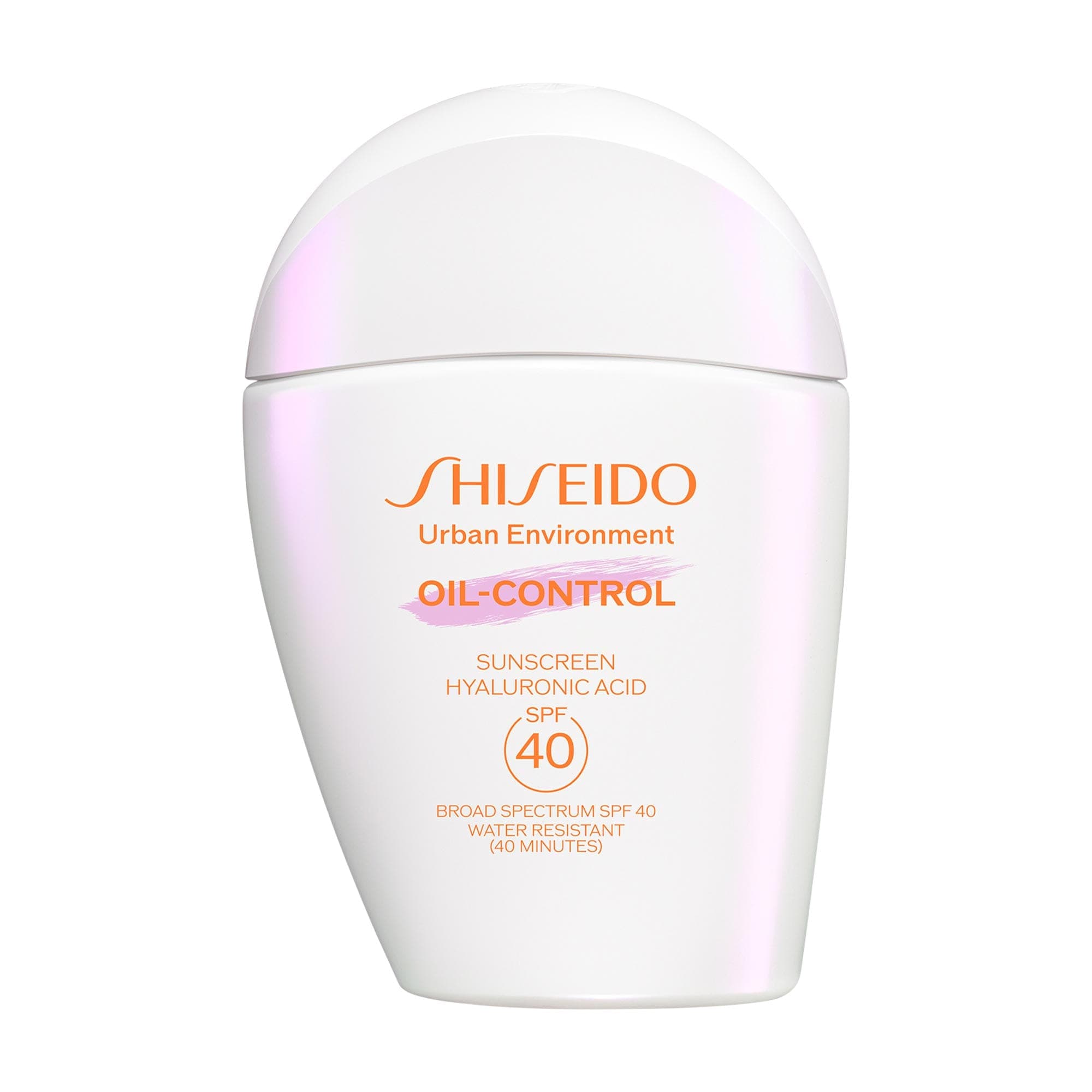
Shiseido Urban Environment Oil-Control Sunscreen SPF 40
Allure’s best overall, under its old name. The US pack sold now is a hybrid (15.5% zinc oxide, 13.6% homosalate, 5% octisalate and 1.1% ensulizole) that no longer says oil-free, and it lists SD Alcohol 40-B 4th, ethylhexyl palmitate and fragrance, though it is water resistant for 40 minutes. Read from Shiseido’s US website: DailyMed has no label for the SPF 40 yet.
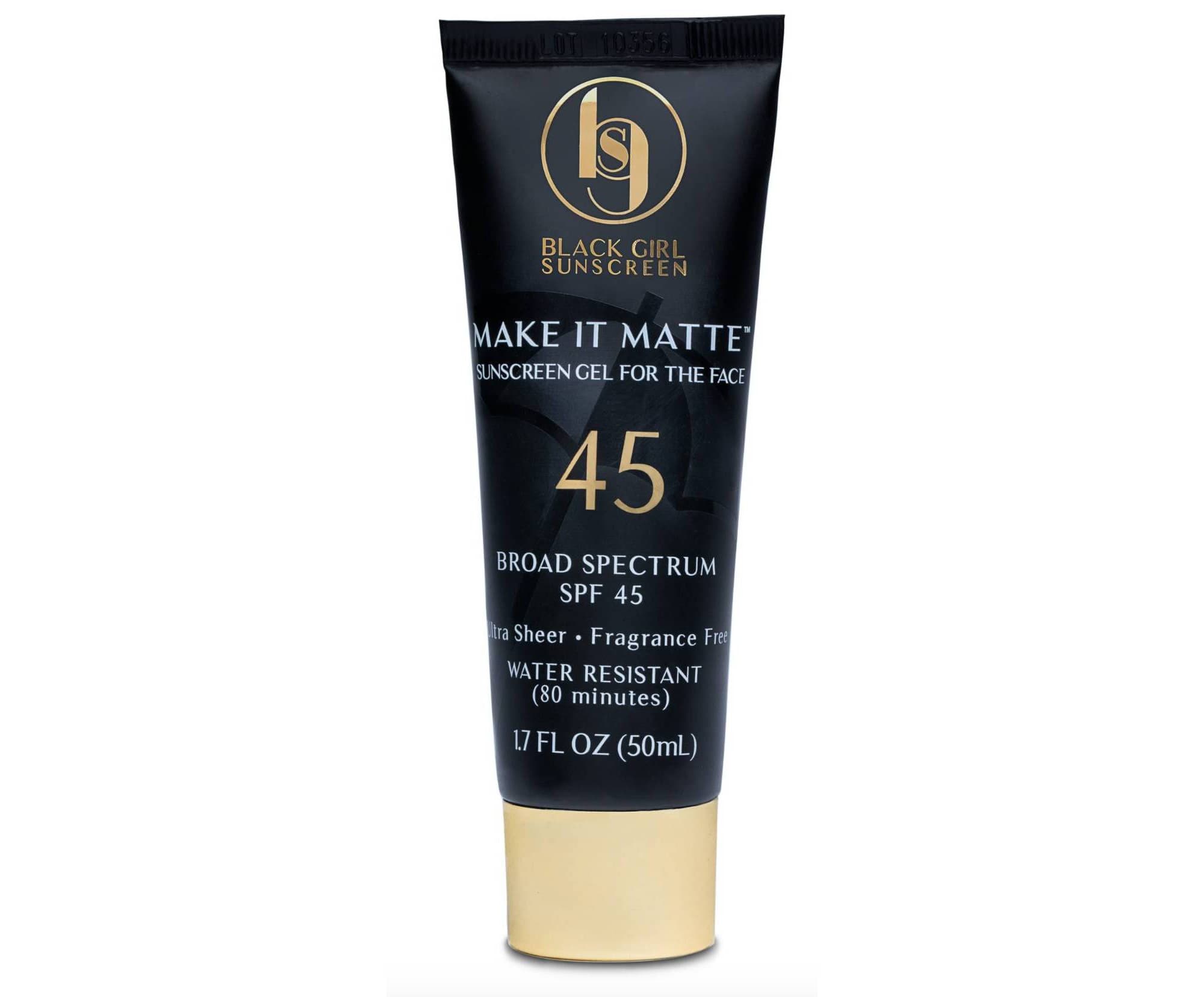
Black Girl Sunscreen Make It Matte SPF 45
A dermatology practice’s reprint of Cosmopolitan’s oily-skin list picks it, and its carton says it is made for women of color who want no white residue. It is water resistant for 80 minutes, lists no fragrance, and has silica and silica silylate to soak up oil. But it lists shea butter, coconut oil and squalane, and neither the pack nor the brand’s site says non-comedogenic or won’t clog pores. Its list is alphabetical, so it says nothing about amounts. Amazon sells it only through third-party sellers; buy it from the brand.
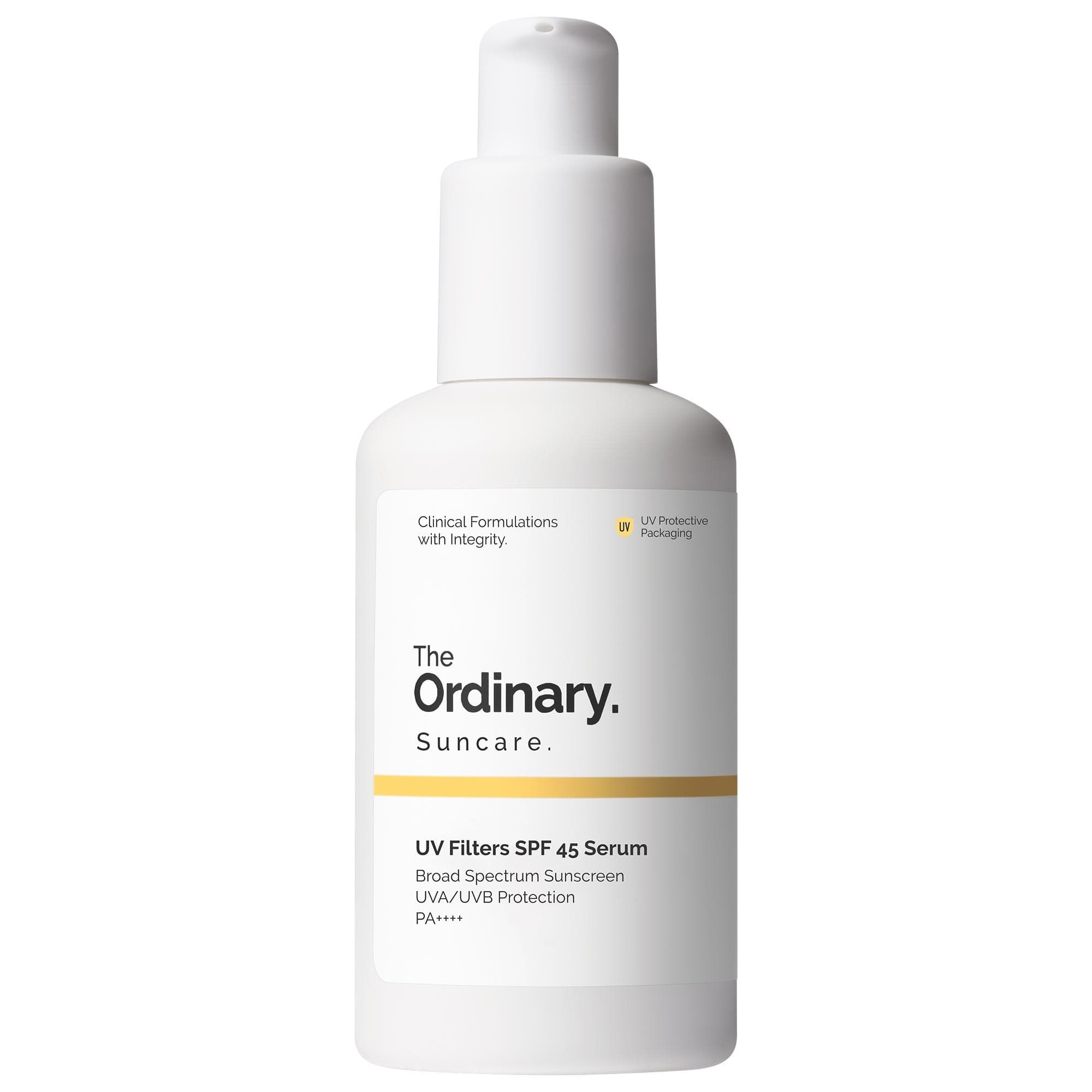
The Ordinary UV Filters SPF 45 Serum
A store best-seller that no guide covers: ninth on Ulta’s oily-skin page and eighth in Amazon’s acne search when we looked. It lists no fragrance and no drying alcohol, its filters are all chemical, and The Ordinary says it is non-comedogenic. But it lists no oil absorber, The Ordinary calls its finish natural-looking luminous, and its list is alphabetical. Fine for acne-prone skin that is not oily.
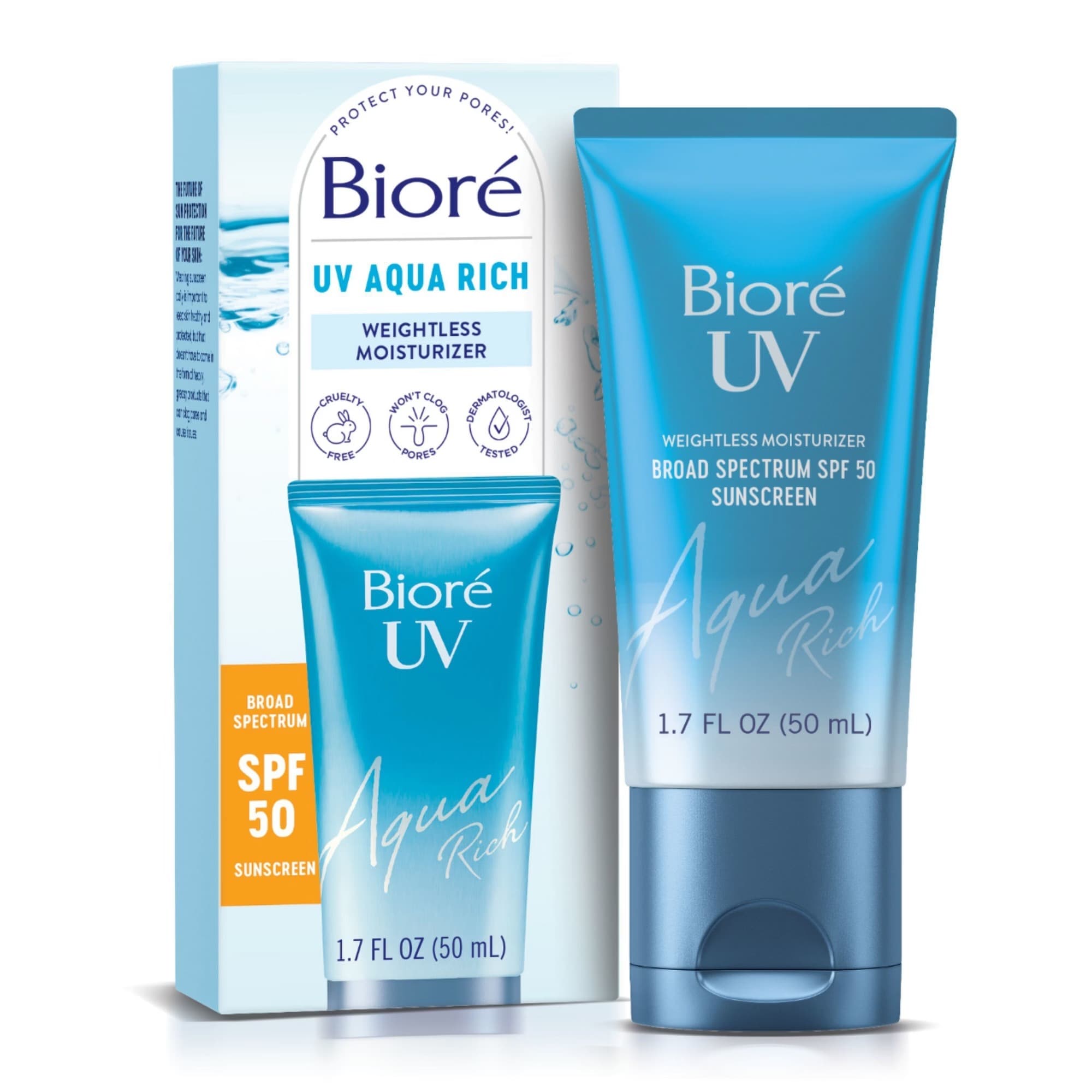
Bioré UV Aqua Rich Weightless Facial Moisturizer SPF 50
In the Reddit threads we read, the sunscreen people name second most, after SKIN1004’s Hyalu-Cica serum (see the questions below), is Bioré’s Japanese Watery Essence, a different formula (an r/SkincareAddiction thread). The US UV Aqua Rich says non-comedogenic, but its carton lists alcohol denat. 2nd, fragrance 9th and four fragrance allergens (limonene, linalool, citral and geraniol), with no oil absorber and no water resistance. One commenter in the same thread says the US version is thicker, orange-scented and stings the eyes.
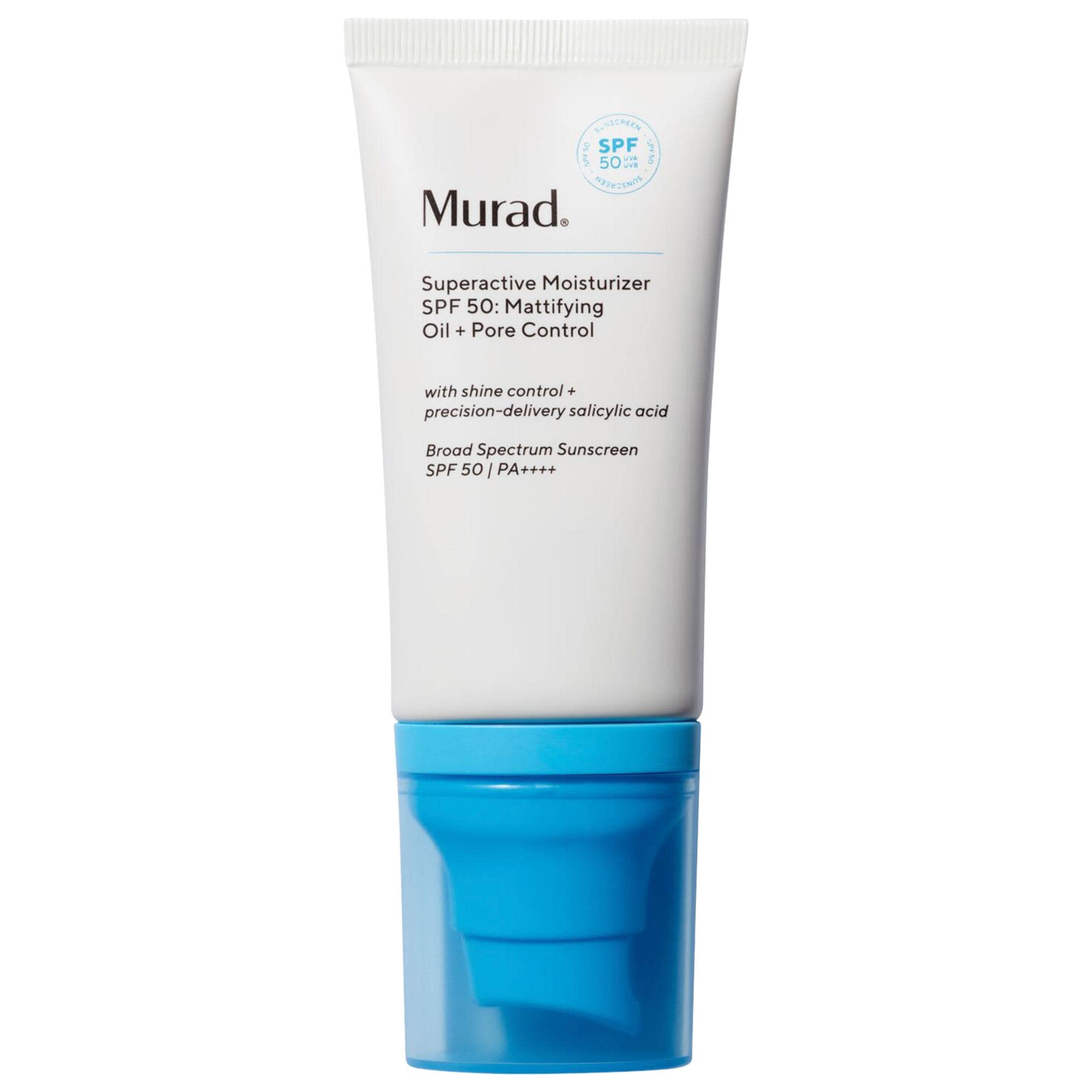
Murad Superactive Moisturizer SPF 50: Mattifying Oil + Pore Control
In Amazon’s results for the acne search, and Murad’s 2025 replacement for its Oil and Pore Control Mattifier SPF 45. Tapioca starch is 2nd, and Murad calls it non-comedogenic with a mattifying finish. But its carton lists fragrance and bitter orange peel oil, with the fragrance allergens limonene, linalool and citral; it also lists avocado oil and hydrogenated vegetable oil, and it is not water resistant. Clinique UV Solutions Mattifying SPF 50 is our fragrance-free matte pick.
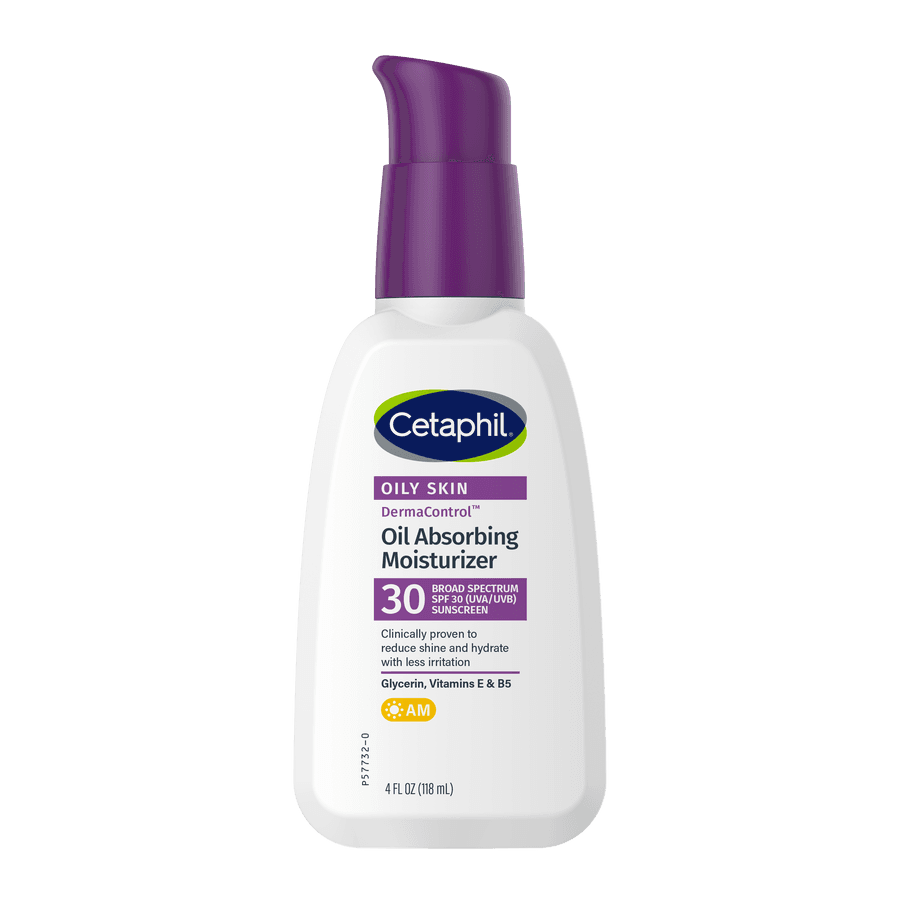
Cetaphil Oil Absorbing Moisturizer SPF 30
Teen Vogue’s best affordable pick, with three oil absorbers (silica, polymethyl methacrylate and aluminum starch octenylsuccinate) and no plant oil, butter, squalane, fragrance or drying alcohol listed. But it is SPF 30 from three chemical filters (3% avobenzone, 5% octisalate and 7% octocrylene), it is not water resistant, its list is alphabetical, and Glamour cut it as too greasy. Differin Oil Absorbing Moisturizer SPF 30 has the same Drug Facts word for word; both are in our oily-skin moisturizers with SPF.
Questions people ask
What is the best sunscreen for acne-prone skin?
EltaMD UV Clear Blemish-Prone SPF 50: 11% zinc oxide and 3.5% octinoxate, 5% niacinamide printed on the carton, no fragrance and no drying alcohol, no oil or butter on the list, and non-comedogenic and won’t clog pores on the pack. For very oily skin, La Roche-Posay Anthelios Clear Skin SPF 60; at the drugstore, Neutrogena Clear Face SPF 50.
Which sunscreen is best for oily skin?
La Roche-Posay Anthelios Clear Skin SPF 60: four oil absorbers (silica, perlite, nylon-12 and methyl methacrylate crosspolymer), no oil or butter, oil-free and fragrance-free on the pack, and water resistant for 80 minutes. The AAD’s oily-skin page also suggests zinc oxide and titanium dioxide; for that, see mineral or chemical.
What is the best drugstore sunscreen for acne-prone skin?
Neutrogena Clear Face SPF 50: water resistant for 80 minutes, with silica and aluminum starch octenylsuccinate and no oil, fragrance or drying alcohol. Neutrogena Clear Face SPF 60 with BEMT and PanOxyl Oil Control SPF 30, 17% zinc oxide alone, are drugstore brands too.
Does sunscreen cause acne, and why does mine break me out?
Some may, but the evidence is thin. The only study we found of sunscreens and pore clogging used rabbits in 1982, and blamed the base, not the UV filters (Mills and Kligman 1982, rabbit study). No trial we found shows that a non-comedogenic sunscreen causes fewer breakouts than another. So read the list: four of the 18 labels on this page list an oil or butter. A patch test, twice a day for 7 to 10 days, catches irritation or allergy, not clogged pores (AAD). If every sunscreen breaks you out, see what to try.
What does non-comedogenic mean on a sunscreen?
That the brand says it will not clog pores. It has no legal definition: an FDA spokesperson told SELF there are no federal definitions for it (SELF), and a review found it regulated by no governing body (Boozalis 2018). The federal sunscreen labeling rule never mentions it (21 CFR 201.327). A brand may back it with a patch test on people’s backs or a clinical trial (Weiss and Caswell 2017). The AAD still says to look for it (AAD).
What ingredients should I avoid in a sunscreen for acne-prone skin?
The AAD’s oily-skin page names two: fragrance and oils. Our screen adds butters, mineral oil, squalane, isopropyl esters and drying alcohol high on the list; those are our rules, not the AAD’s. Some guides also say to avoid silicones. The AAD pages we read do not, and more than half of 52 moisturizers made for acne contain dimethicone, glycerin or both (Chularojanamontri 2014).
Is oil-free sunscreen really free of oil?
Usually it means no mineral or plant oil (Chularojanamontri 2014), but nothing defines the word (Boozalis 2018). In our catalog, 4 of 20 face sunscreens with “oil-free” in the name list an oil, butter, squalane or isopropyl ester. Read the list, not the name.
Is mineral or chemical sunscreen better for acne-prone skin?
The AAD gives two answers. Its sunscreen guide says only to look for non-comedogenic or won’t clog pores (AAD); its oily-skin page says zinc oxide and titanium dioxide, with no fragrance or oils (AAD). Neither cites a study for it. None of the 18 labels on this page pairs the two minerals; PanOxyl Oil Control SPF 30 comes closest, and La Roche-Posay Anthelios Mineral Zinc Oxide SPF 50 (5% zinc oxide and 6% titanium dioxide) is an exact match, in our mineral sunscreen picks.
What sunscreen do dermatologists recommend for acne-prone and oily skin?
The AAD, the dermatologists’ professional group, asks that every sunscreen have SPF 30 or higher, broad spectrum and water resistance, and for acne-prone and oily skin, “non-comedogenic” or “won’t clog pores” on the label (AAD, AAD). Of our picks, only La Roche-Posay Anthelios Clear Skin SPF 60 prints the AAD’s words and is water resistant.
Does SPF level matter for acne-prone or oily skin?
The AAD asks for SPF 30 or higher for everyone (AAD). Our picks run from SPF 30 to SPF 60. SPF comes from a sunburn test (21 CFR 201.327) and says nothing about pores; for those, read the base.
Is gel sunscreen better for oily skin?
The AAD’s sunscreen guide suggests gels for hairy areas; for oily skin it asks only for “non-comedogenic” or “won’t clog pores” (AAD). It gives no texture rule for oily skin, so read the list either way: no oils or butters, and oil absorbers if you shine.
Does sunscreen help acne?
It is not an acne treatment. In a small trial run with Beiersdorf, Eucerin’s maker, acne and marks kept improving in people on adapalene who added either of two sunscreens, but no group went without sunscreen (How 2023); a review by authors including two from the sunscreen maker ISDIN found only four relevant studies (Piquero-Casals 2023). What sunscreen does is protect skin that some acne medicines make more sensitive to the sun (AAD), and help keep dark marks from getting darker (AAD).
Does sunscreen help acne scars and dark spots?
For dark spots, yes, as part of the plan. The AAD’s page on dark spots in darker skin tones says to treat the acne first, then wear a tinted sunscreen with iron oxide (AAD). In a lamp study of 20 people with brown to dark skin, visible light darkened skin more, and for longer, than long-wave UVA (Mahmoud 2010; its trial registration lists Johnson & Johnson, then Neutrogena’s owner, as a collaborator: ClinicalTrials.gov). Ultra Violette Unblock Screen SPF 50 lists three iron oxides and no fragrance; for more shades, see our tinted sunscreen picks. Raised or pitted scars are a different problem, for a dermatologist (AAD).
I use tretinoin, adapalene, benzoyl peroxide or doxycycline: what sunscreen should I use?
All four come with sun advice: Differin Gel’s label says to limit sun exposure and use sunscreen (Differin), benzoyl peroxide labels must say to use a sunscreen (21 CFR 333.350), retinoids can make skin more sensitive to the sun (AAD), and doxycycline’s label warns of an exaggerated sunburn reaction (Doryx MPC). The AAD advises a broad-spectrum, water-resistant SPF 30 or higher that is non-comedogenic (AAD). Of our picks, only La Roche-Posay Anthelios Clear Skin SPF 60 prints the AAD’s words and is water resistant. For sensitive skin, the AAD’s retinoid page suggests zinc oxide and/or titanium dioxide (AAD): PanOxyl Oil Control SPF 30 has zinc oxide alone.
Does oil or sweat make sunscreen wear off?
Nobody has measured whether skin oil lowers SPF: we found no study. Sweat does wash sunscreen off and move it around, in lab tests on a sweating skin model (Keshavarzi 2021, with authors from a sunscreen maker). Reapply at least every two hours (FDA), and after 40 or 80 minutes of swimming or sweating if the label claims water resistance (21 CFR 201.327).
Why does my sunscreen make my face oily, and how do I stop the shine?
The AAD’s oily-skin page says to skip sunscreens with fragrance or oils. Pick a list with no oil or butter, and with oil absorbers, like La Roche-Posay Anthelios Clear Skin SPF 60’s four. Your own oil comes back too: skin wiped clean is at its usual oiliness again within about two hours (Rode 2000). At midday, the AAD suggests blotting papers, pressed on rather than rubbed (AAD).
Does tinted sunscreen cause acne?
We found no study that says a tint does. Iron oxides are color additives (21 CFR 73.1200), and the AAD suggests a tinted sunscreen with iron oxide for dark spots, non-comedogenic if your skin is oily (AAD). The checks stay the same: no oils or butters, no fragrance. Ultra Violette Unblock Screen SPF 50 is tinted with neither, and so is Supergoop! Mineral Mattescreen SPF 40, our tinted sunscreen pick for oily skin. EltaMD UV Clear Tinted SPF 46, the acne-prone pick in those tinted picks, lists isopropyl palmitate, an isopropyl ester our screen leaves out.
Is there a fungal-acne-safe sunscreen?
None of the 21 sunscreen labels we read for this page claims it. A 2021 review, co-written by an employee of the ingredient maker Symrise, says lipids applied to the skin may either feed or slow Malassezia, the yeast behind fungal acne, and calls their effect hardly studied (Mayser and Koch, 2021). If you think you have fungal acne, ask a dermatologist.
Is EltaMD UV Clear good for acne-prone skin?
The label is a good fit. EltaMD UV Clear SPF 46: 9% zinc oxide and 7.5% octinoxate, 16 inactive ingredients, no fragrance and no drying alcohol, no oil, and a carton that says non-comedogenic and names acne and rosacea. EltaMD’s newer EltaMD UV Clear Blemish-Prone SPF 50 has more zinc oxide (11%) and also prints won’t clog pores. Both list niacinamide, which some Reddit users blame for breakouts or hives (Reddit).
EltaMD UV Clear or La Roche-Posay Clear Skin?
EltaMD UV Clear SPF 46 has 9% zinc oxide and 7.5% octinoxate, no oil absorber and no water resistance. La Roche-Posay Anthelios Clear Skin SPF 60 has four chemical filters, four oil absorbers and water resistance for 80 minutes. For very oily skin and sweat, Clear Skin; for zinc oxide and redness, UV Clear.
Is La Roche-Posay sunscreen good for acne?
Its Clear Skin is: the pack says oil-free, won’t clog pores, non comedogenic and fragrance-free, and the list has silica, perlite, nylon-12 and methyl methacrylate crosspolymer. For mineral filters, its La Roche-Posay Anthelios Mineral Zinc Oxide SPF 50 lists 5% zinc oxide and 6% titanium dioxide (our sensitive-skin pick for oily skin).
What is BEMT (bemotrizinol) in sunscreen?
A UV filter the FDA allowed in US sunscreens in June 2026, its first new sunscreen active in about 20 years, at up to 6% (FDA). Neutrogena Clear Face SPF 60 with BEMT lists 6%, and Ultra Violette Unblock Screen SPF 50 3%.
Is Supergoop Unseen good for acne-prone skin?
Its carton says non-comedogenic, but it lists shea butter. In the Reddit threads we read, 7 of the 21 people who gave a verdict on it said it broke them out, four of them in 2025 or 2026, after the SPF 50 replaced the SPF 40, and one commenter blames its shea butter (an r/SkincareAddiction thread). That is community opinion, not evidence.
Is SKIN1004 Hyalu-Cica good for acne-prone skin?
It is the sunscreen named most in the Reddit threads we read: 39 people gave a verdict on it, and 7 said it broke them out (an r/AsianBeauty thread); that is community opinion. Much of that talk may be about the Korean version: the US SKIN1004 Hyalu-Cica Water-Fit Sun Serum SPF 50 is a separate formula, and Reddit users who compared the two found the US one thicker, with more white cast (one thread). Its US label, which we read on October 6, 2026, lists four chemical filters, with silica and polymethylsilsesquioxane to soak up oil and no oil, butter, fragrance or drying alcohol; it is not water resistant. More in our Korean sunscreen picks.
Is Black Girl Sunscreen good for acne-prone skin?
Make It Matte lists shea butter, coconut oil and squalane, and neither its pack nor its site says non-comedogenic or won’t clog pores, though it is water resistant for 80 minutes. For deep skin tones with no white mineral filters and a pore claim, see Neutrogena Clear Face SPF 60 with BEMT.
Is Bioré UV Aqua Rich good for acne-prone skin?
The US Bioré UV Aqua Rich and the Japanese Watery Essence that Reddit praises are different products (Reddit). The US carton says non-comedogenic, but lists alcohol denat. 2nd, fragrance and four fragrance allergens.
Sources
- American Academy of Dermatology: How do I know if I'm using the right sunscreen?
- American Academy of Dermatology: How to control oily skin
- American Academy of Dermatology: Acne, tips for managing
- American Academy of Dermatology: 10 skin care habits that can worsen acne
- American Academy of Dermatology: Acne diagnosis and treatment
- American Academy of Dermatology: Retinoid or retinol?
- American Academy of Dermatology: How to fade dark spots in darker skin tones
- American Academy of Dermatology: Acne scars: Consultation and treatment
- American Academy of Dermatology: How to apply sunscreen
- American Academy of Dermatology: How to test skin care products
- American Academy of Dermatology: Face washing 101
- American Academy of Dermatology: How to prevent skin cancer
- American Academy of Dermatology: 9 things to try when acne won't clear
- A.A. Newton, SELF (republished on Yahoo): Here's How to Tell if Your Skin-Care Products Are Actually Noncomedogenic (2019)
- Boozalis and Patel: Clinical utility of marketing terms used for over-the-counter dermatologic products, Journal of Dermatological Treatment (2018)
- FDA: Cosmetics labeling claims
- 21 CFR 201.327: labeling and effectiveness testing of OTC sunscreens (eCFR)
- U.S. Food and Drug Administration: Sunscreen: how to help protect your skin from the sun
- 21 CFR 201.66: format and content requirements for over-the-counter drug labeling (eCFR)
- FDA: "Alcohol free" cosmetic labeling claims
- 21 CFR 73.1200: synthetic iron oxide, a color additive for drugs (eCFR)
- U.S. Food and Drug Administration: FDA expands sunscreen options for the first time in 20 years (June 2026)
- Dermatology Times: Neutrogena launches new sunscreens with newly permitted UV filter bemotrizinol (September 2026)
- DailyMed (U.S. National Library of Medicine): FDA drug labels and Drug Facts
- eCFR: 21 CFR Part 333, Subpart D, Topical acne drug products for over-the-counter human use
- DailyMed: Differin Gel (adapalene gel 0.1%) Drug Facts label
- DailyMed: Doryx MPC (doxycycline hyclate delayed-release tablets), Mayne Pharma, prescribing information (revised 3/2025)
- Mills and Kligman: Comedogenicity of sunscreens, experimental observations in rabbits, Archives of Dermatology (1982)
- Mills and Kligman: A human model for assessing comedogenic substances, Archives of Dermatology (1982)
- Fulton, Pay and Fulton: Comedogenicity of current therapeutic products, cosmetics, and ingredients in the rabbit ear, Journal of the American Academy of Dermatology (1984)
- Draelos and DiNardo: A re-evaluation of the comedogenicity concept, Journal of the American Academy of Dermatology (2006)
- Weiss and Caswell (Consumer Product Testing Company, a contract lab that runs these tests): Non-comedogenic and non-acnegenic claim substantiation, Journal of Cosmetic Science (2017)
- Chularojanamontri and others: Moisturizers for acne, what are their constituents? Journal of Clinical and Aesthetic Dermatology (2014)
- Piquero-Casals et al. (co-authored by ISDIN, a sunscreen maker): Sun exposure, a relevant exposome factor in acne patients and how photoprotection can improve outcomes, Journal of Cosmetic Dermatology (2023)
- How et al. (Beiersdorf, which makes Eucerin): Efficacy and tolerability of a sunscreen containing licochalcone A and L-carnitine as an adjunct to retinoids in the management of acne and post-acne pigmentation among Malaysian patients, Clinical, Cosmetic and Investigational Dermatology (2023)
- Draelos et al.: The effect of 2% niacinamide on facial sebum production, Journal of Cosmetic and Laser Therapy (2006)
- Rode, Ivens and Serup: Degreasing method for the seborrheic areas with respect to regaining sebum excretion rate to casual level, Skin Research and Technology (2000)
- Endly and Miller: Oily skin, a review of treatment options, Journal of Clinical and Aesthetic Dermatology (2017)
- Keshavarzi et al. (co-authored by Riemann, maker of P20 sunscreen): In vitro skin model for characterization of sunscreen substantivity upon perspiration, International Journal of Cosmetic Science (2021)
- Lourenco and others: Application of SPF moisturisers is inferior to sunscreens in coverage of facial and eyelid regions, PLoS One (2019)
- Levin et al.: Allergen content of inactive ingredients in best-selling sunscreens, a comparison of key product features, Contact Dermatitis (2026)
- Mahmoud et al.: Impact of long-wavelength UVA and visible light on melanocompetent skin, Journal of Investigative Dermatology (2010)
- ClinicalTrials.gov NCT00478751: Impact of long wavelength UVA and visible light on melanocompetent skin (Henry Ford Health System, with Johnson & Johnson as a collaborator)
- Lyons et al.: Photoprotection beyond ultraviolet radiation, a review of tinted sunscreens, Journal of the American Academy of Dermatology (2021)
- Passeron et al. (ISDIN, a sunscreen maker): An investigator-blinded, randomized trial of a broad-spectrum sunscreen containing sclareolide and niacinamide for the prevention of post-inflammatory hyperpigmentation in skin of color, Dermatology and Therapy (2026)
- The Skin Cancer Foundation: Making your sunscreen work with your makeup
- EltaMD: UV Clear Blemish-Prone & Oil Balancing SPF 50 (US product page)
- Ultra Violette: Unblock Screen SPF 50 Breakout-Friendly SKINSCREEN (US product page)
- Reddit, r/SkincareAddiction: "People with acne prone skin what is the best sun screen you have ever used?" (2025)
- Reddit, r/SkincareAddiction: "Anyone else breakout after using sunscreen?" (2023)
- Reddit, r/SkincareAddiction: "Sunscreen that doesn't break me out or have any white cast / leave me greasy!" (2024)
- Reddit, r/SkincareAddiction: "Every SPF I try causes acne. What to do?!" (2024)
- Reddit, r/acne: "I'm on tretinoin. Sunscreen makes me breakout. What can I do? Just stay indoors forever?" (2022)
- Reddit, r/AsianBeauty: "People with acne prone skin, which sunscreen works best?" (2024)
- Reddit, r/koreanskincare: "skin1004 sunscreen US version" (2026)
- Mayser: Malassezia spp., interactions with topically applied lipids, a review, Der Hautarzt (2021)
Written by Avina Picks. Not clinically reviewed, and not a treatment plan: ask a dermatologist about a skin condition, a prescription, pregnancy or breastfeeding.
Sunscreen works on the days you wear it
Avina keeps your morning routine with your real products, sunscreen last, and records the days you did it, so daily protection becomes a streak you can see.

More from Avina Picks
- Sensitive-skin sunscreen
The Best Sunscreens for Sensitive Skin
Vanicream Facial Moisturizer SPF 30 is our pick: zinc oxide alone, no fragrance and no plant extracts. For rosacea-prone skin, Tower 28's SOS FaceGuard, which holds both the eczema and the rosacea seal; for SPF 50, Cetaphil's Sheer Mineral Face Drops.Updated - Oily skin
The Best Moisturizers for Oily Skin
La Roche-Posay's Toleriane Double Repair Matte is our pick: 16 ingredients, with silica, corn starch and perlite to soak up oil, niacinamide, and no fragrance. For ceramides as well, CeraVe's Oil Control Gel-Cream; for oily but dehydrated skin, The Ordinary's Natural Moisturizing Factors + Beta Glucan.Updated - Acne face wash
The Best Face Washes for Acne
CeraVe's Acne Foaming Cream Cleanser is our pick: 4% benzoyl peroxide in a cream wash with ceramides, and no fragrance. For salicylic acid, The Inkey List's 2% cleanser; for body acne, PanOxyl's 10% wash.Updated